Reduced Pallet Height
The same 300 lb shipment occupies less vertical space.
Before
48 × 40 × 36 in · 7.50 PCF · Class 125
After
48 × 40 × 32 in · 8.44 PCF · Class 100
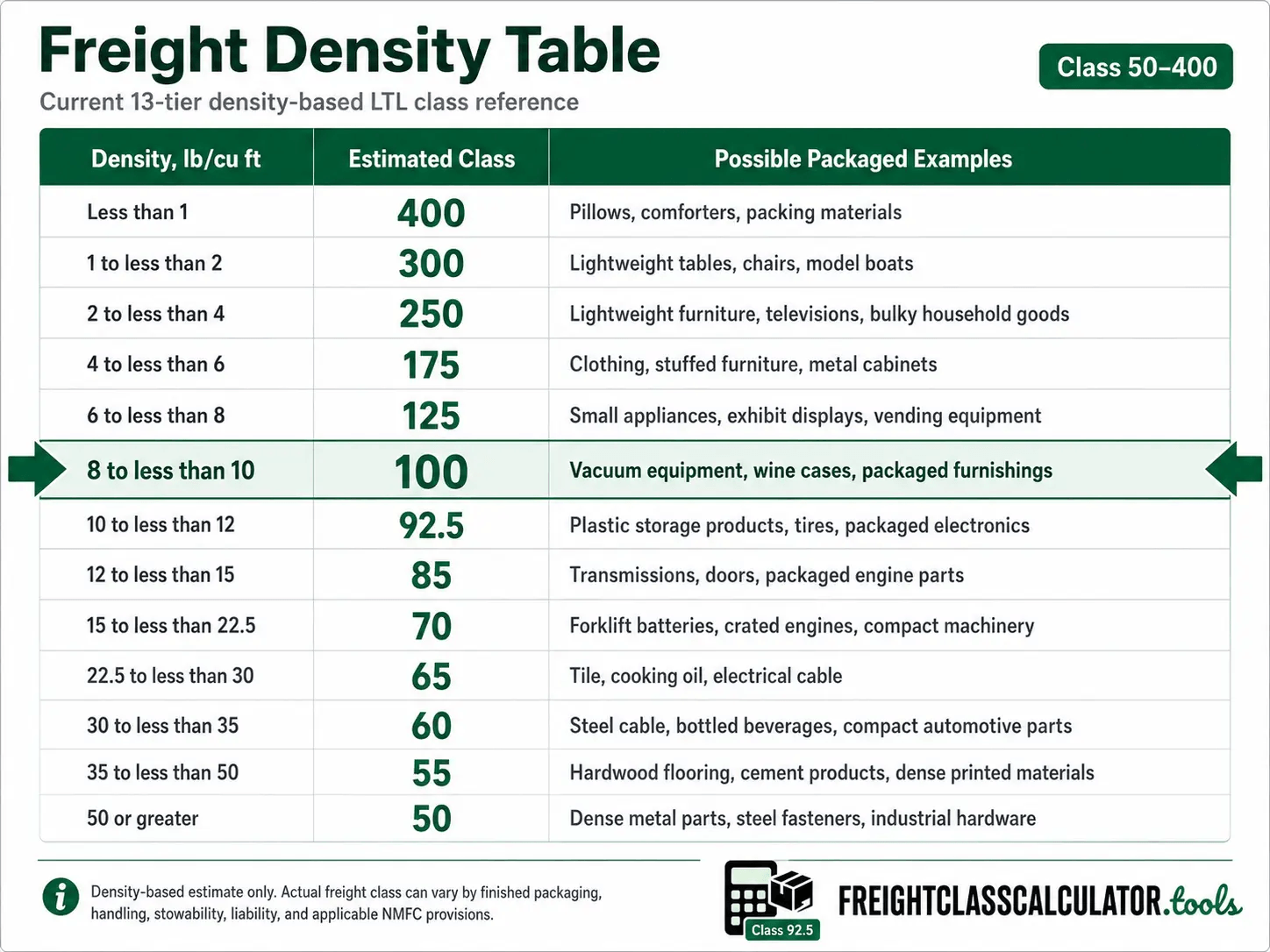
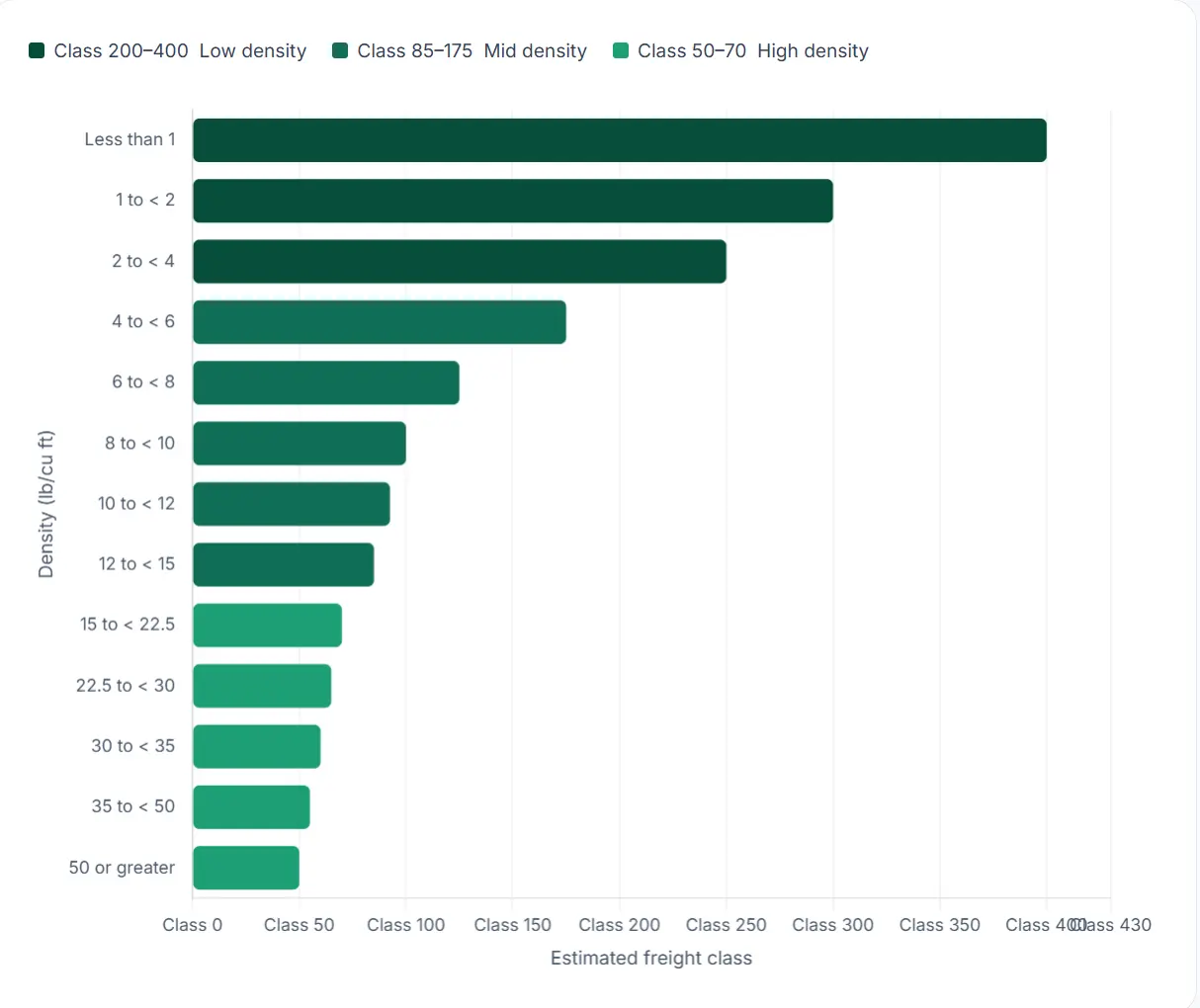
Use this freight class chart to compare packaged shipment density with estimated LTL freight classes across the current 13-tier scale.
Measurement Units
Applies to the shipment dimensions and weight below.
Example Density & Class Result
Estimated Class
Density range: 8 to less than 10 lb/cu ft
100
Density
Packaged shipment density
9.38lb/cu ft
Total Cubic Feet
Total packaged volume
53.33cu ft
Weight at next tier
Cube at next tier
Planning comparison only. Always enter the shipment’s actual tendered weight and greatest outside dimensions.
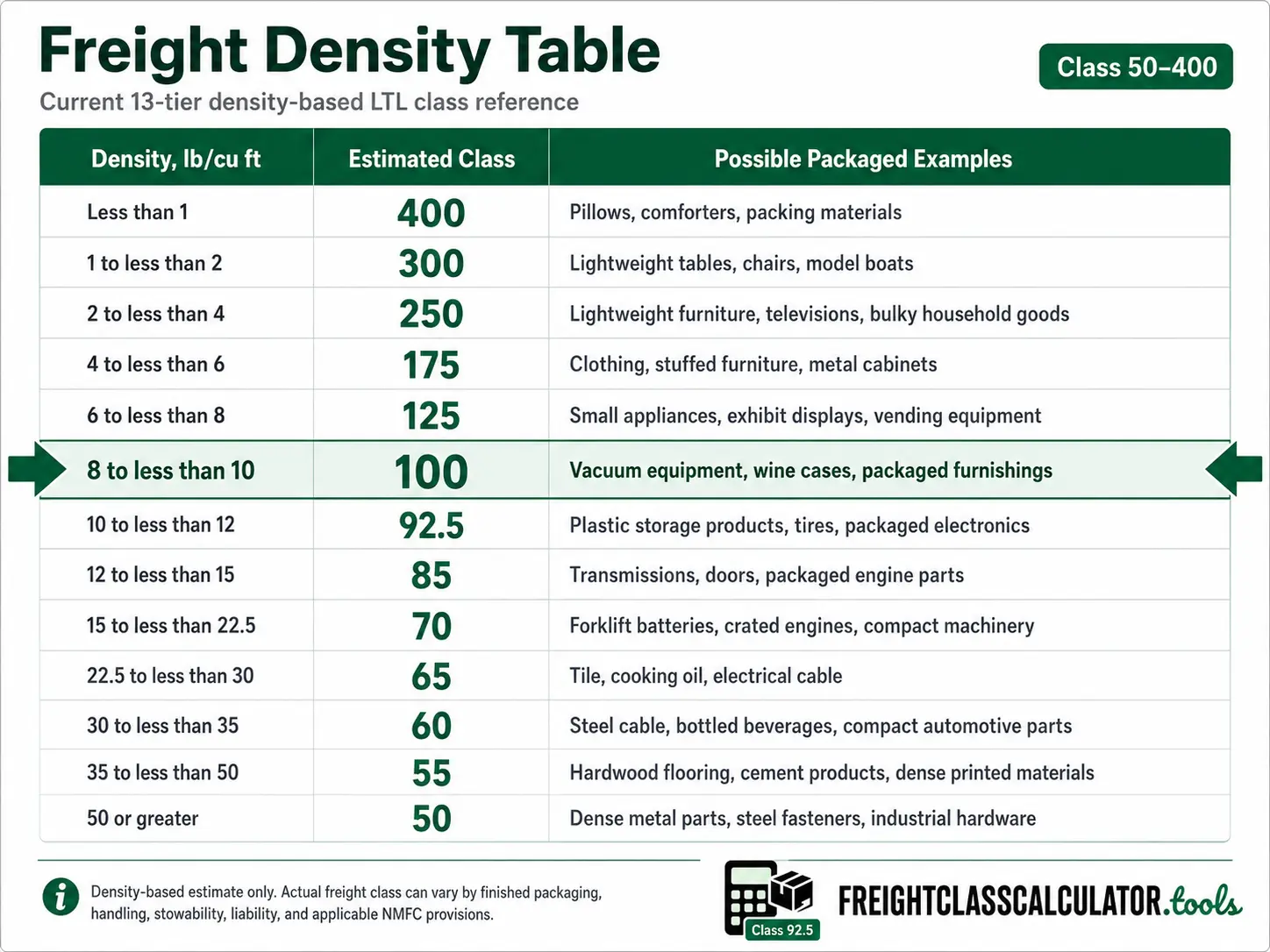
Your calculated density is highlighted automatically in the table below. Already know your packaged density? Find the range containing that value, then read across to the estimated class and possible packaged examples.
| Density, lb/cu ft | Estimated Class | Possible Packaged Examples | Class Guide |
|---|---|---|---|
|
Breakpoint Rule:
Tier ranges include the lower limit and exclude the upper limit.
Example: 8.00 PCF → Class 100; 7.99 PCF → Class 125
|
|||
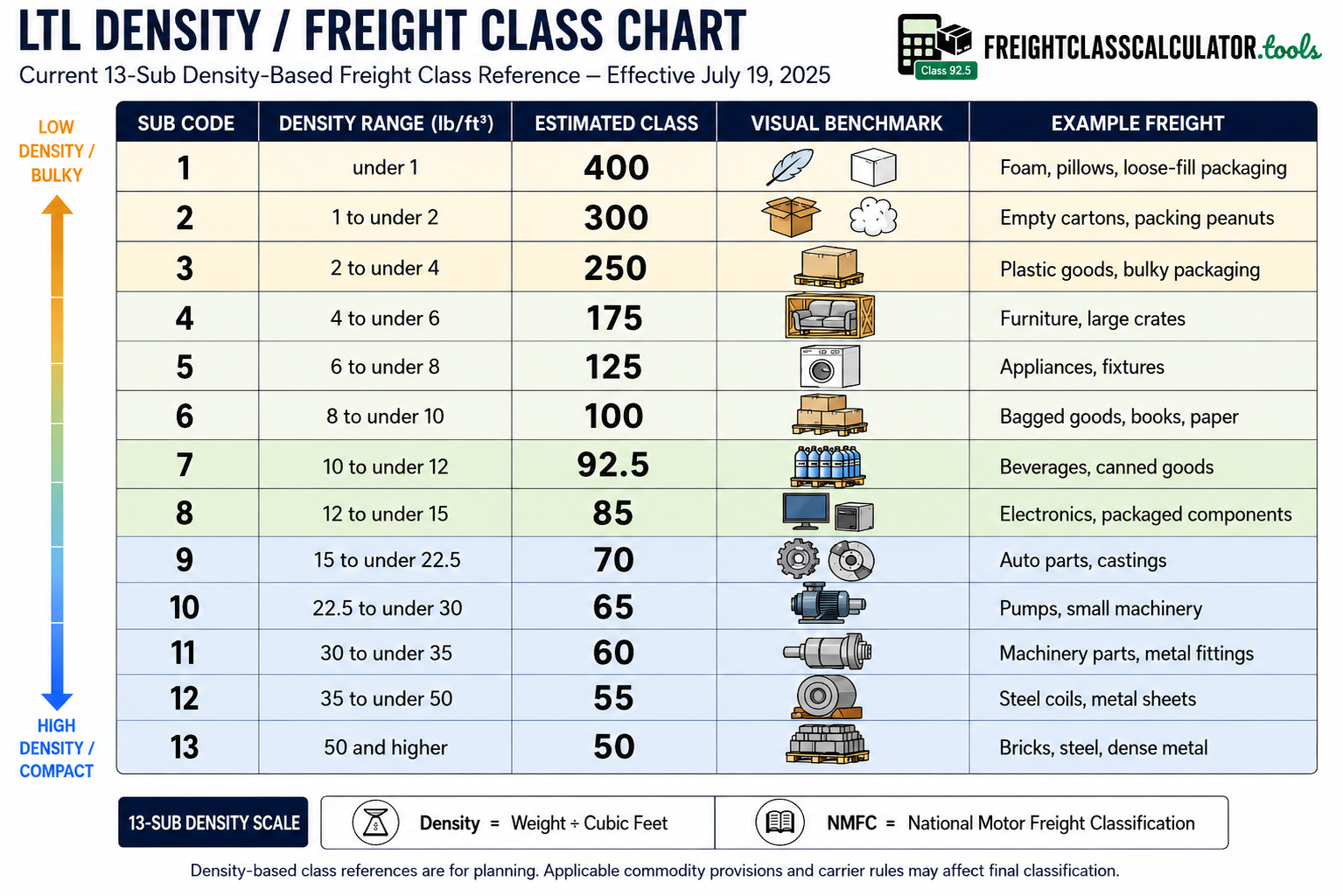
| Less than 1 | 400 | Pillows, comforters, packing materials | Freight Class 400 |
| 1 to less than 2 | 300 | Lightweight tables, chairs, model boats | Freight Class 300 |
| 2 to less than 4 | 250 | Lightweight furniture, televisions, bulky household goods | Freight Class 250 |
| 4 to less than 6 | 175 | Clothing, stuffed furniture, metal cabinets | Freight Class 175 |
| 6 to less than 8 | 125 | Small appliances, exhibit displays, vending equipment | Freight Class 125 |
| 8 to less than 10 | 100 | Vacuum equipment, wine cases, packaged furnishings | Freight Class 100 |
| 10 to less than 12 | 92.5 | Plastic storage products, tires, packaged electronics | Freight Class 92.5 |
| 12 to less than 15 | 85 | Transmissions, doors, packaged engine parts | Freight Class 85 |
| 15 to less than 22.5 | 70 | Forklift batteries, crated engines, compact machinery | Freight Class 70 |
| 22.5 to less than 30 | 65 | Tile, cooking oil, electrical cable | Freight Class 65 |
| 30 to less than 35 | 60 | Steel cable, bottled beverages, compact automotive parts | Freight Class 60 |
| 35 to less than 50 | 55 | Hardwood flooring, cement products, dense printed materials | Freight Class 55 |
| 50 or greater | 50 | Dense metal parts, steel fasteners, industrial hardware | Freight Class 50 |
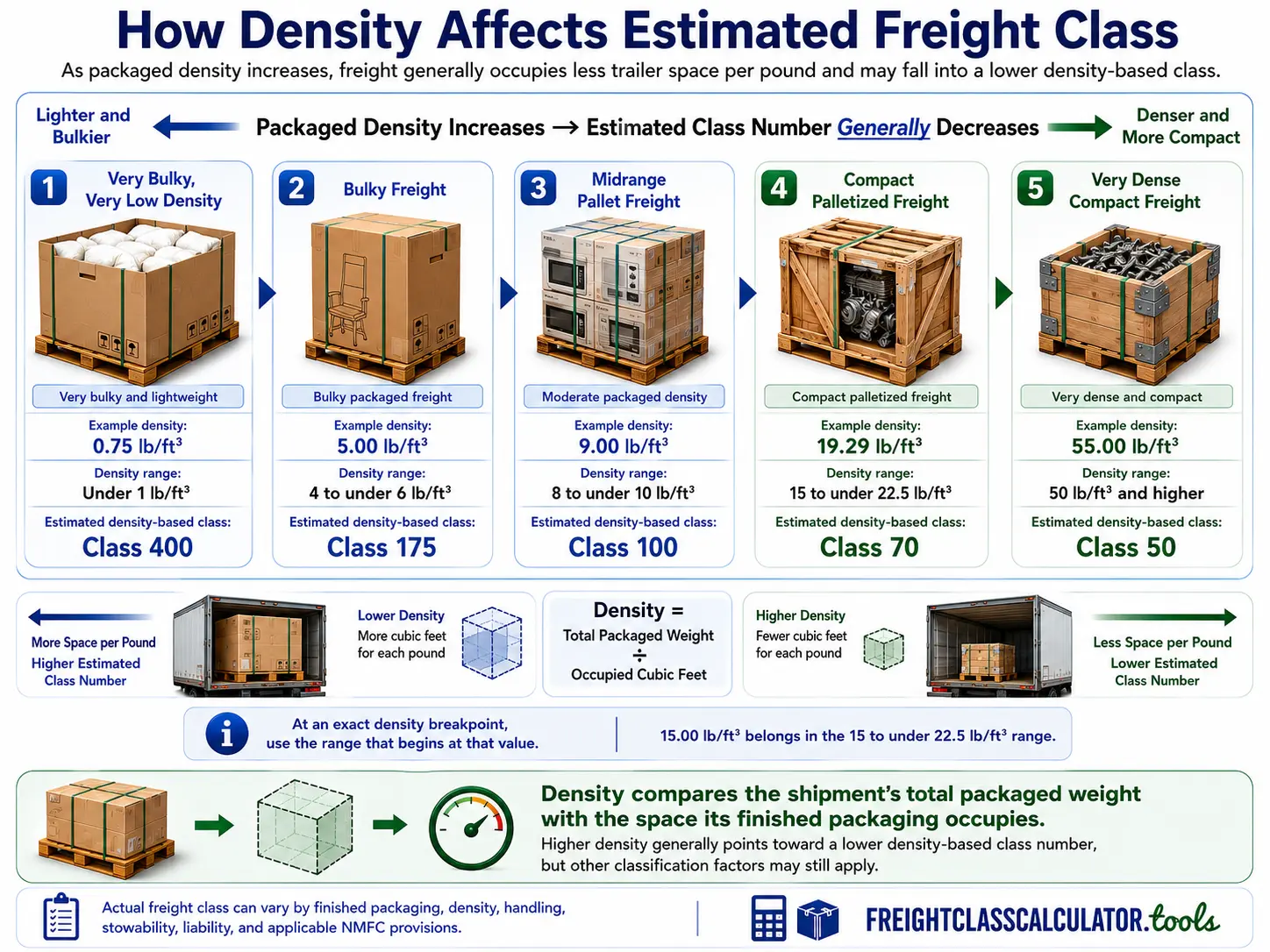
A 48 × 40 × 42 inch shipment weighing 900 lb occupies 46.67 cubic feet and has a density of 19.29 lb/ft³. That falls in the 15 to under 22.5 lb/ft³ range, which maps to an estimated Class 70.
Exact breakpoint: use the row beginning at that value. For example, 10.00 PCF belongs in the 10 to less than 12 PCF range.
Off-scale class note
Classes such as 77.5, 110, 200, and 500 may appear in NMFC or carrier classification contexts but are not part of this density-based chart.
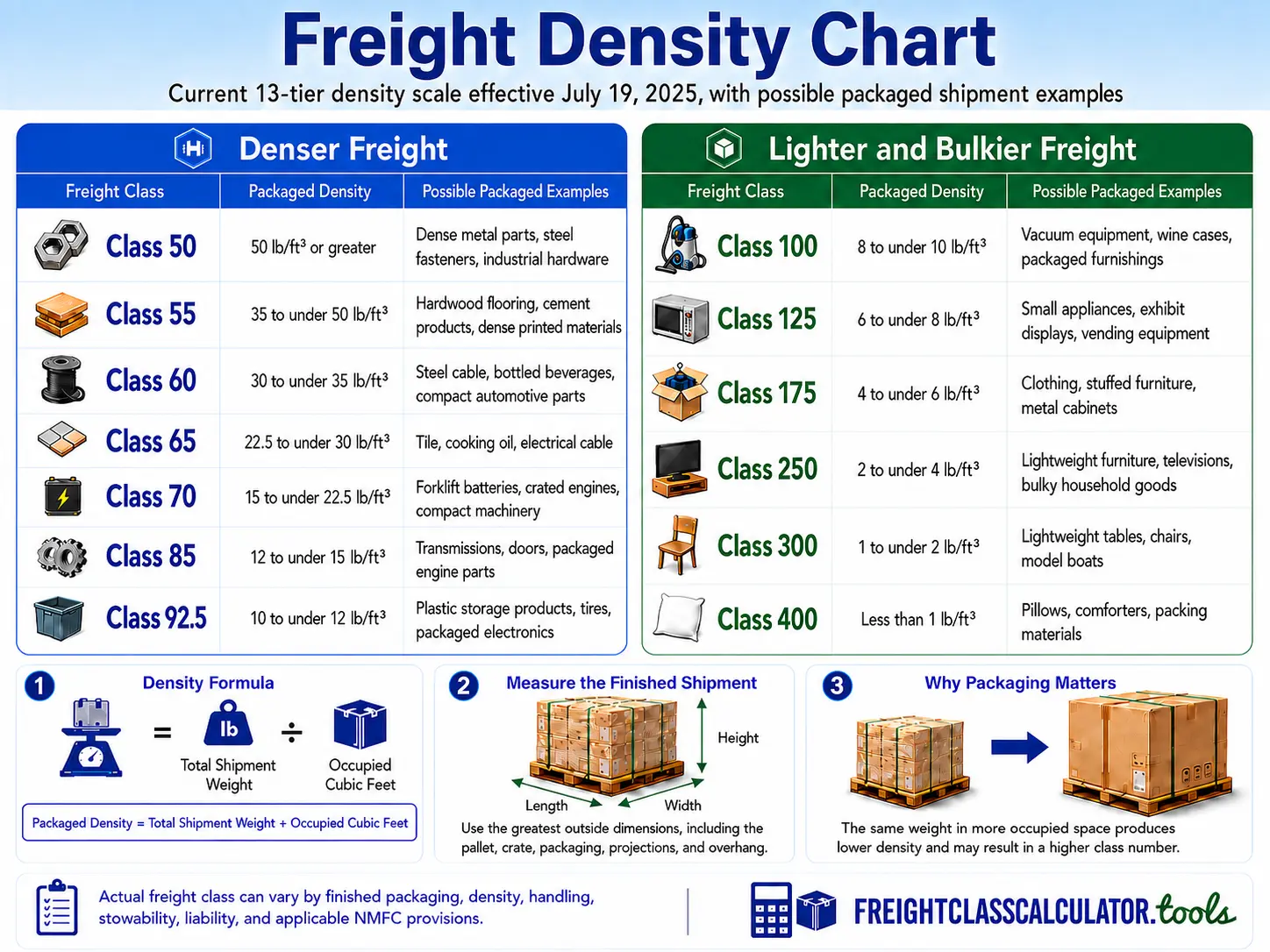
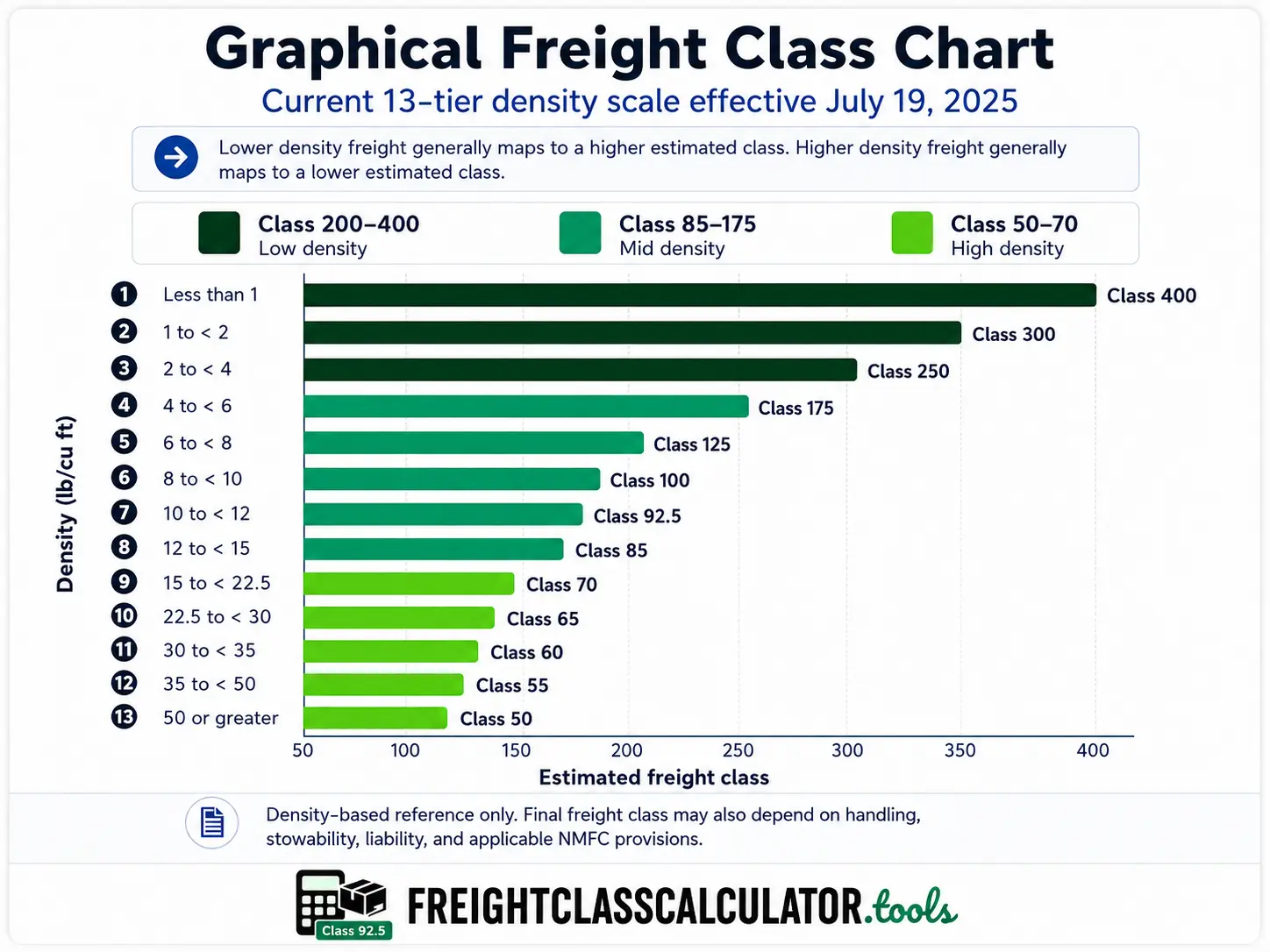
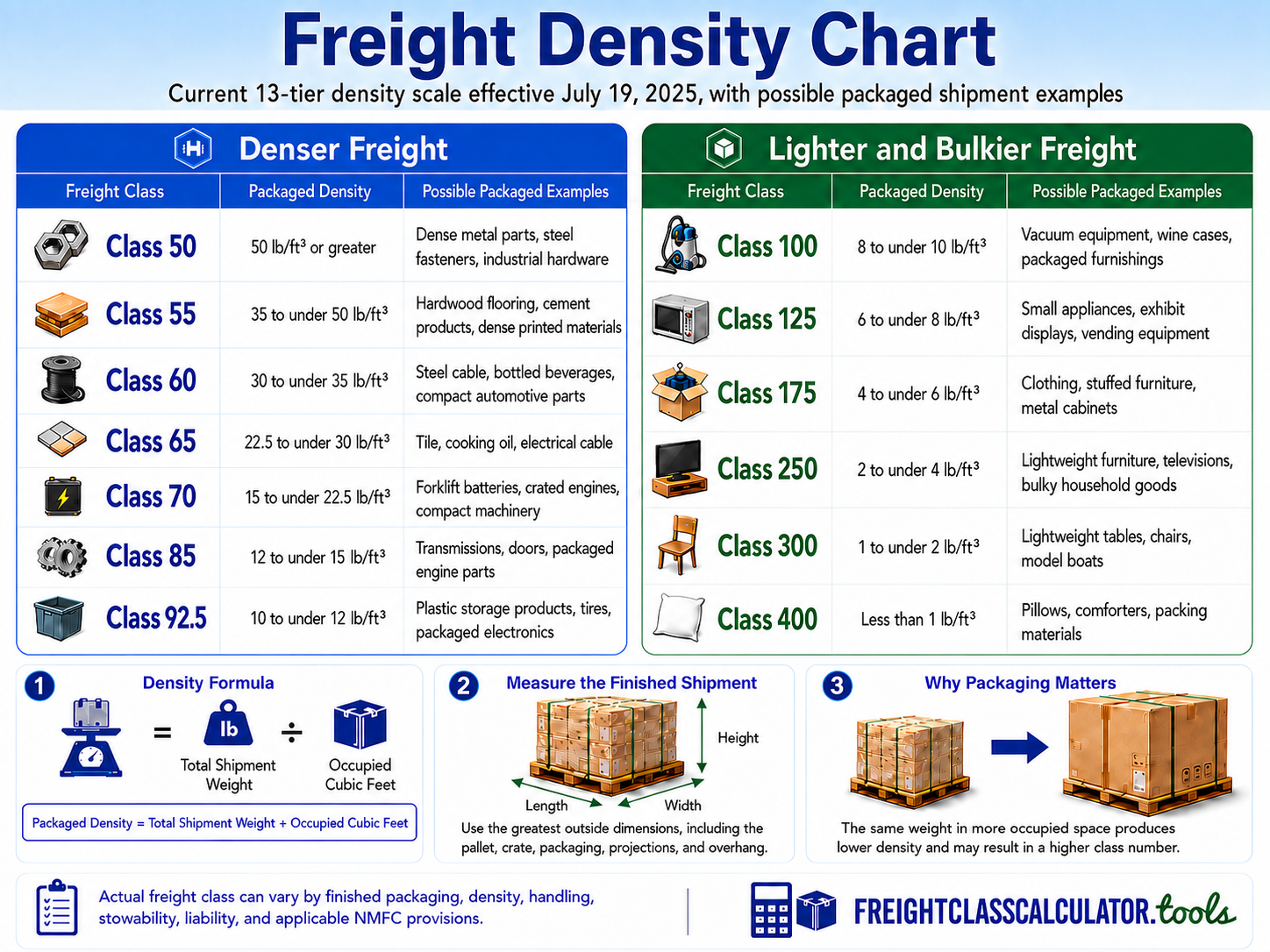
Within this density-based scale, lighter and bulkier freight generally maps to a higher class number, while denser freight generally maps to a lower class number. The relationship applies to the packaged shipment—not the unpackaged product.
Click for full size
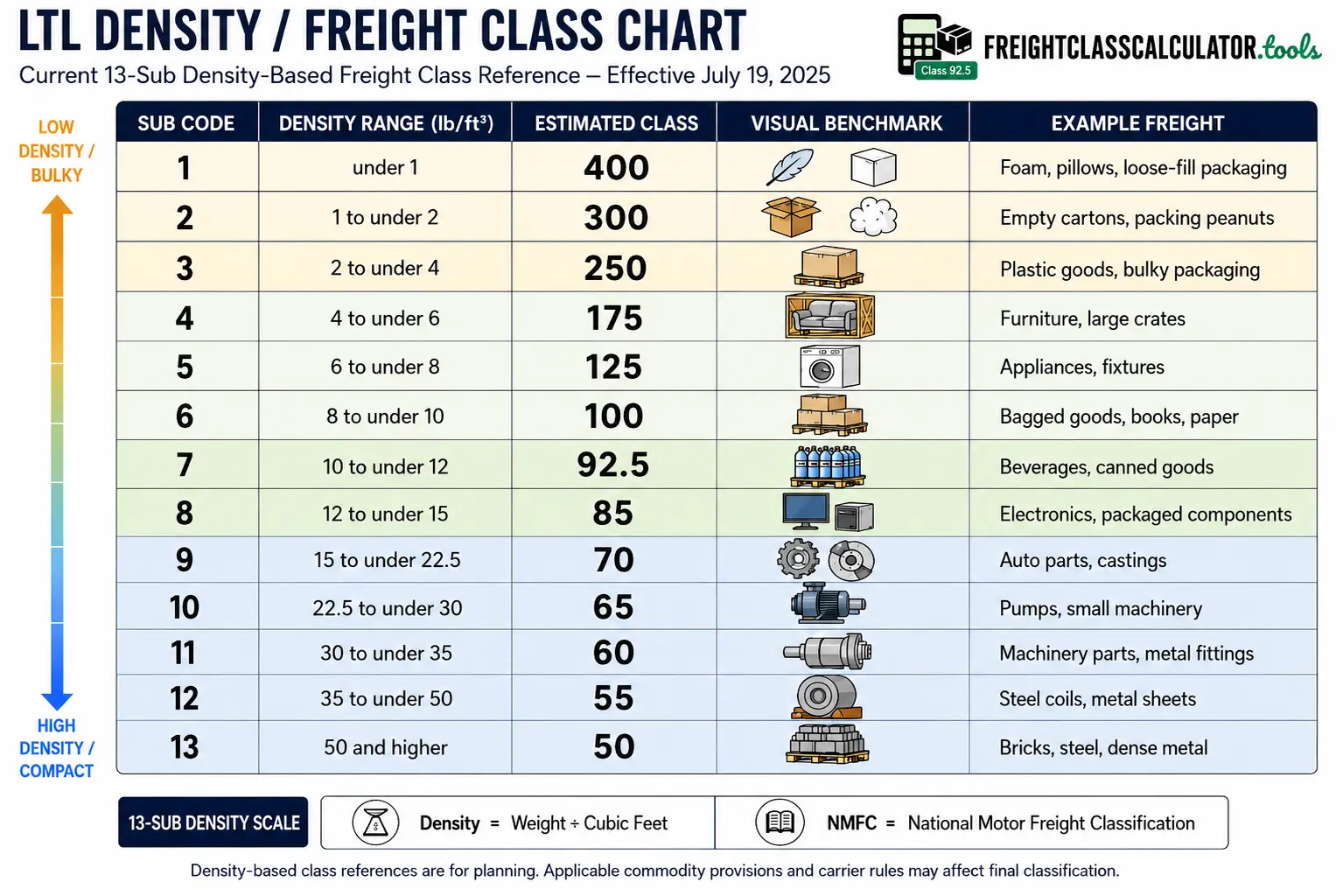
This chart produces a density-based planning estimate. The applicable NMFC item and other transportation characteristics may lead to a different final classification.
Click for full size
Use the greatest straight-line outside length, width, and height of each handling unit as tendered. Include pallets, crates, wrap, projections, bulges, and overhang. For pallet-specific planning, use the Pallet Freight Class Calculator.
Click for full size
Measure the finished handling unit rather than the product alone. Include pallet height, overhang, protective packaging, and projections; use actual shipment weight; calculate separately handled units separately; and do not round dimensions down.
Click for full size
These examples show how the same weight can map to a different density tier when the actual packaged dimensions change.
Click for full size
The same 300 lb shipment occupies less vertical space.
Before
48 × 40 × 36 in · 7.50 PCF · Class 125
After
48 × 40 × 32 in · 8.44 PCF · Class 100
A smaller outside footprint raises density.
Before
52 × 44 × 40 in · 13.22 PCF · Class 85
After
48 × 40 × 40 in · 15.75 PCF · Class 70
Reducing crate height moves the shipment into a denser tier.
Before
60 × 48 × 48 in · 20.00 PCF · Class 70
After
60 × 48 × 40 in · 24.00 PCF · Class 65
Examples use the shipment’s actual greatest outside dimensions after packaging. Select a button to load the after dimensions into the calculator.
Density Formula
Density (PCF) = Total Packaged Weight ÷ Total Cubic Feet
One cubic foot contains 1,728 cubic inches.
Click for full size
View, print, or download freight class and density charts using the current 13-tier density scale. Choose the format that works best for quick reference or shipment planning.
Explore shipment examples, packaging considerations, and calculator guidance for common freight categories.
Machinery Freight Class
Skidded, crated, irregular, and oversized machinery shipments.
Machine Parts Freight Class
Packaging and density considerations for machine components.
Engines Freight Class
Crated, palletized, and protected engine shipments.
Cabinets Freight Class
Cabinet construction, packaging, and shipment-density examples.
Electronics Freight Class
Packaged electronics, equipment, and handling considerations.
Furniture Freight Class
Palletized, boxed, assembled, and flat-packed furniture.
Freight Class Lookup
Browse freight class pages for machinery, electronics, furniture, food, packaging, hose, and auto parts.
Enter the packaged dimensions and weight above, or find a known PCF value in the chart. The matching row shows the density-based estimated class.
Use the tier whose lower limit matches the result. Exactly 10.00 PCF falls in the 10 to less than 12 PCF tier.
Recheck the complete packaged dimensions and weight, including the pallet, wrap, crate, carton, and any overhang. Small measurement differences can move the result into a nearby range.
Use the Freight Density Calculator when you know the shipment dimensions and weight but do not yet know the pounds-per-cubic-foot value. Use this chart after the density has already been calculated.
Yes. Use the greatest outside dimensions of the complete handling unit, including packaging, projections, and overhang as tendered.
No. Density is central to this estimate, but handling, stowability, liability, and the applicable NMFC item can affect final classification.
Reference Scope
This page provides a density-based freight class reference for planning estimates using the current 13-tier LTL density scale effective July 19, 2025. It does not reproduce the NMFC, provide an official item classification, quote carrier pricing, interpret tariffs, or replace review by a carrier, broker, NMFC resource, or ClassIT+.