Choose shipment type
Use Same size / weight for identical pieces. Use Different sizes / weights when dimensions or weight changes.

How to use
Use Same size / weight for identical pieces. Use Different sizes / weights when dimensions or weight changes.
Measure the full outside size, including pallet, crate, carton, wrap, and overhang.
Check freight class, density, cubic feet, total weight, and any carrier review warnings.
Calculator logic
This tool calculates density-based LTL freight class from shipment density. It also works as a freight volume calculator because it converts packaged length, width, height, quantity, and item groups into total cubic feet before mapping the combined density to a freight class. Single-item and multi-item values from the Freight Density Calculator can be transferred into this calculator, including dimensions, weight, quantity, and units.
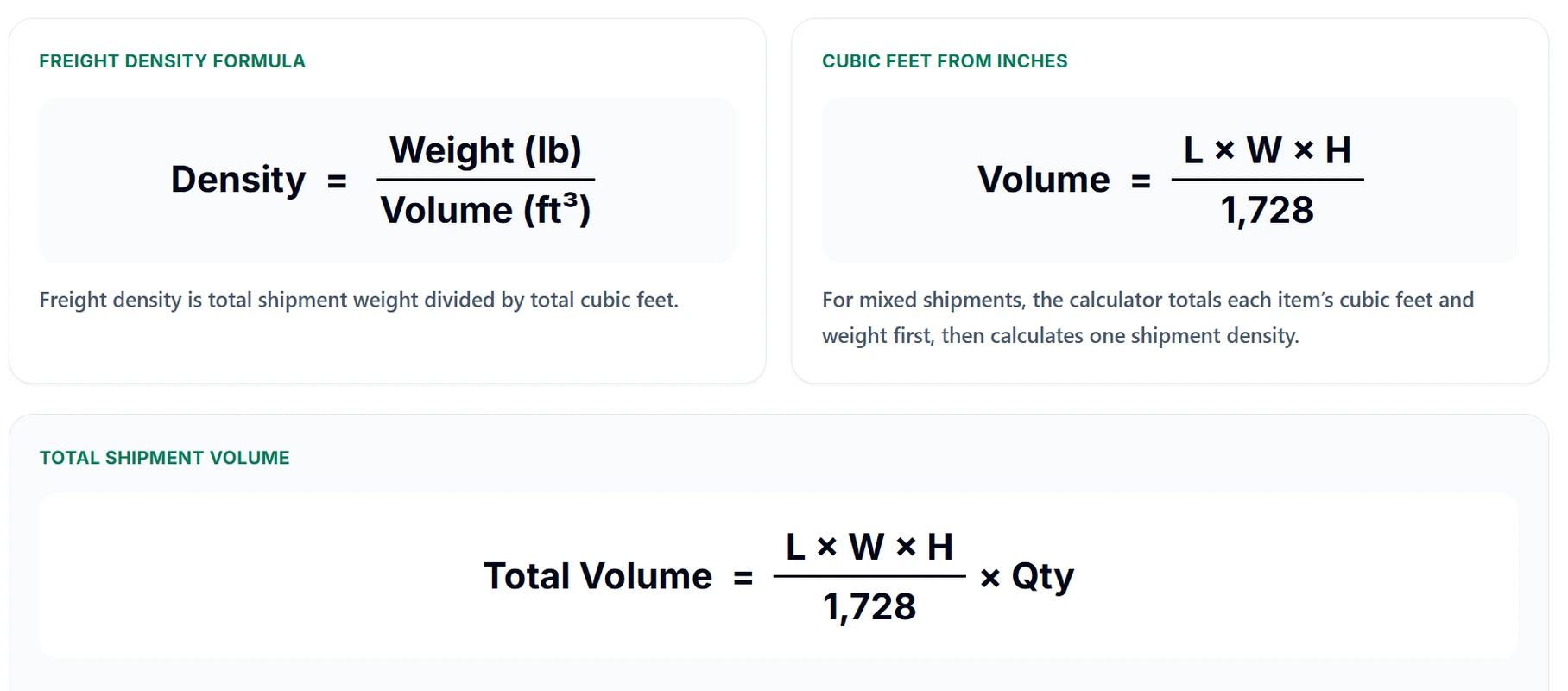
Freight Density Formula
Freight density is total shipment weight divided by total cubic feet.
Cubic Feet From Inches
For mixed shipments, the calculator totals each item’s cubic feet and weight first, then calculates one shipment density.
Total Shipment Volume
The calculator totals shipment volume and weight first, then compares the final density against the density class scale to calculate one density-based freight class.
Field Example
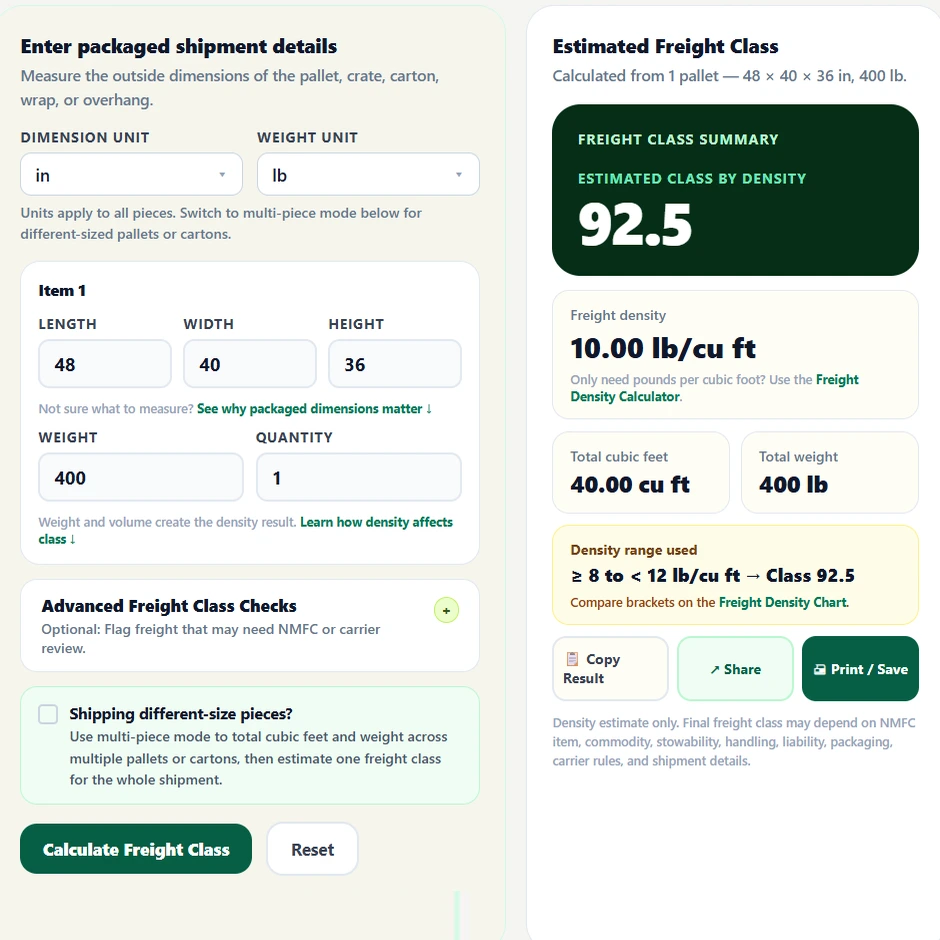
In this example let us consider a shipment that measures 48 × 40 × 36 inches and weighs 400 lb — that gives you 40.00 cubic feet of volume. Now we divide the weight by the volume: 400 ÷ 40.00 = 10.00 lb/cu ft, which places this shipment in Class 92.5.
One packaged handling unit
Volume
40.00 ft³
48 × 40 × 36 ÷ 1,728
Density
10.00 lb/ft³
400 lb ÷ 40.00 ft³
Estimated Class
92.5
Density-based result
Please note: This example uses one packaged shipment. For mixed shipments, the calculator totals all item volumes and weights before calculating the final density.
Calculator Results
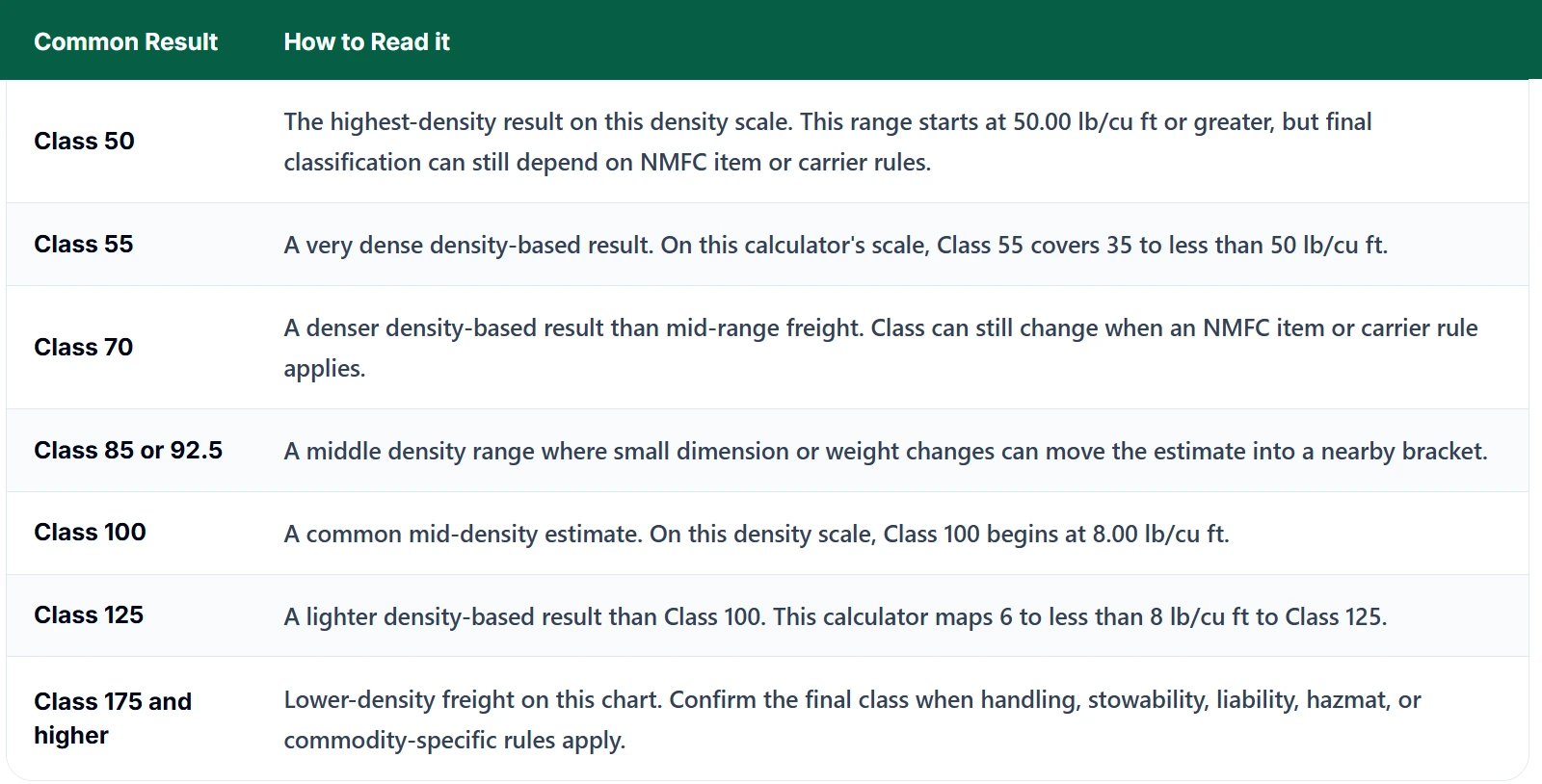
Freight class is a rating category used for LTL shipments. Lower density-based classes generally reflect denser freight, while higher classes generally reflect lighter or lower-density freight. The class itself is not a freight price; carriers use class along with lane, weight, accessorials, discounts, and tariff rules to rate a shipment.
| Common Result | How to Read it |
|---|---|
| Class 50 | The highest-density result on this density scale. This range starts at 50.00 lb/cu ft or greater. |
| Class 55 | A very dense result. On this calculator's scale, Class 55 covers 35 to less than 50 lb/cu ft. |
| Class 70 | A denser result than the middle freight-class ranges. |
| Class 85 or 92.5 | A middle density range where small dimension or weight changes can move the result into a nearby bracket. |
| Class 100 | A common mid-density result. On this density scale, Class 100 begins at 8.00 lb/cu ft. |
| Class 125 | A lighter result than Class 100. This calculator maps 6 to less than 8 lb/cu ft to Class 125. |
| Class 175 and higher | Lower-density freight on this chart, generally using more trailer space per pound. |
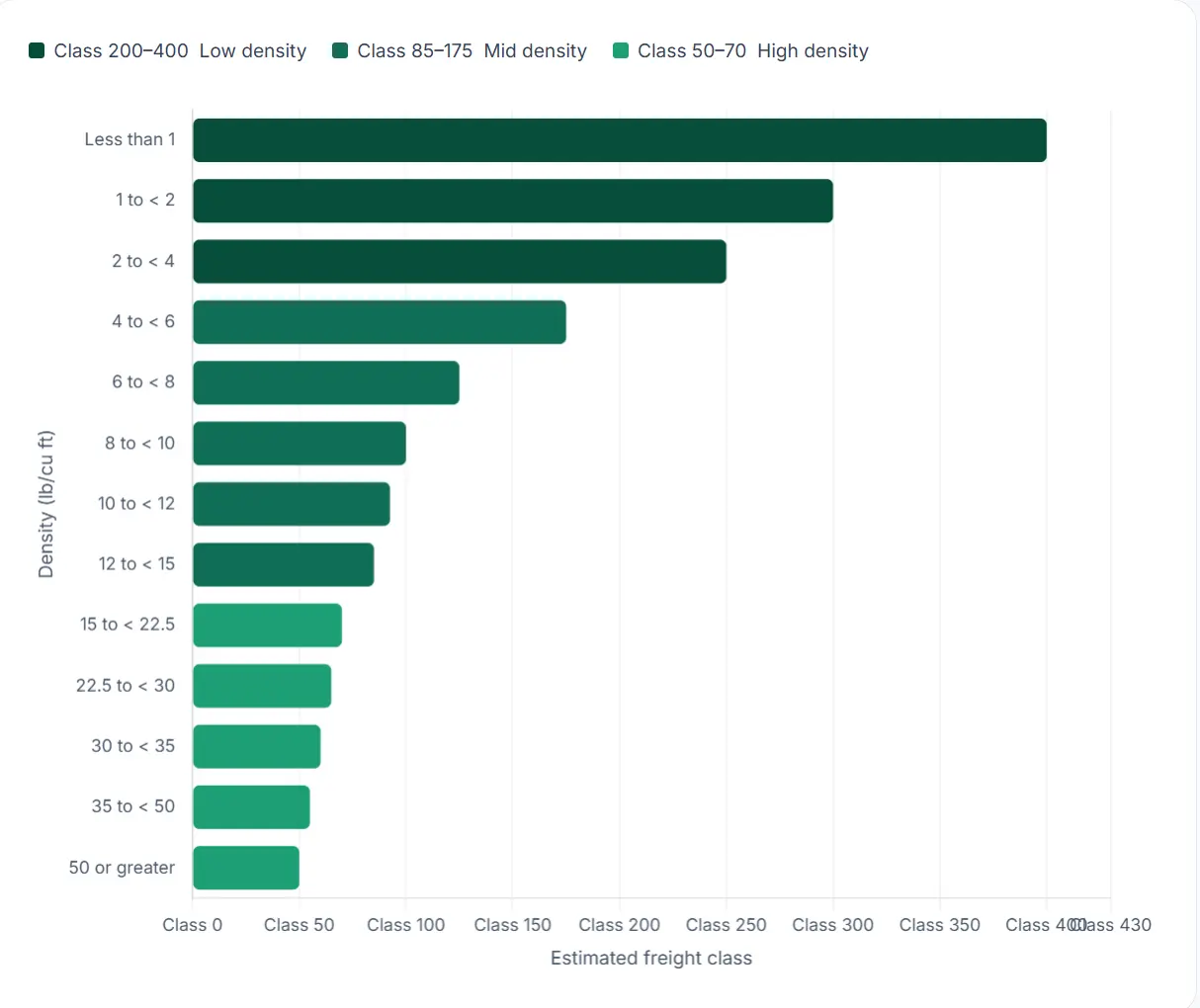
See the Freight Density Chart for the complete density bracket table.
Measurement accuracy
A few inches or pounds can matter more than you'd expect. Carrier inspectors measure the full packaged shipment — pallet, wrap, crate, overhang and all — so if your dimensions don't account for that, the estimate and the final bill may not match.
Near-threshold Results Need Extra Attention
Near-threshold results are especially sensitive to small differences in measured dimensions, pallet height, packaging, or shipment weight.
Near-Threshold Weight Check
When a shipment lands close to the next density bracket, it's useful to know exactly how much weight separates it from crossing that line. For example, a 40.00 cu ft pallet sitting at 7.00 lb/cu ft would need 320 lb total to hit 8.00 lb/cu ft and move into the Class 100 range. The same idea works in reverse if you already know the weight and want to figure out the volume instead.
Freight planning calculators
Use the freight class, density, pallet, and linear-feet tools together to plan packaged LTL freight.
Commodity guides
Explore shipment examples, packaging considerations, and calculator guidance for common freight categories.
Optional references
Open these supporting images only when you want a visual example of the calculator or its output.
Common questions
Yes. Add a separate item group for each different size or weight. The calculator combines all item volumes and weights into one shipment-level density and freight class.
Yes. Measure the complete packaged shipment, including the pallet, crate, carton, wrap, and any overhang.
The calculator totals the cubic feet and weight for all entered item groups, calculates shipment density in pounds per cubic foot, and matches that density to the corresponding freight class bracket used by the tool.
Small differences in packaged dimensions or weight can move the shipment density into a neighboring class bracket. The calculator displays a threshold notice when the result is close to the next range.