
Diesel Price$6.382
Greenspark Fuel Surcharge Calculator
Fuel Surcharge Calculator
QUICK LINKS
Calculate Fuel Surcharge Per Mile or as a % of Net Linehaul
Choose the calculation method that matches how you need to calculate fuel surcharge.
Need help getting started?Check these guides to understand this method.
MPG method guide
How to Use the Fuel Index / MPG Method
- 1Choose the EIA benchmark.
Select the U.S. national average or the PADD region required by your agreement. For an EIA sub-region such as California, use its table row and type that price into the diesel field.
- 2Enter the baseline.
Use the baseline fuel price stated in the agreement (also called the fuel peg or base price).
- 3Confirm loaded MPG.
Enter the loaded MPG used by the agreement for the standard MPG formula. If you enable the contract step schedule, MPG is not used to calculate the step result.
- 4Enter loaded shipment miles.
Use the loaded miles that the surcharge applies to under the agreement.
- 5Calculate and review the breakdown.
Check the surcharge per mile, total fuel surcharge, and exact calculation details before using the result.
Contract terms come first. For a different benchmark week or sub-region, type the required diesel price into the editable diesel field. If the agreement uses a different rounding rule, apply that rule to the exact-breakdown figures. If it uses a step schedule, enter the agreement's step increment and rate per step.
Formula guide
How the Fuel Index / MPG Formula Works
The standard MPG method converts the diesel-price increase above the contract baseline into a loaded-mile surcharge. If the current diesel price is at or below the baseline, the surcharge is $0.00.
Step 1Current diesel price − Baseline = Price increase
Step 2Price increase ÷ Loaded MPG = Fuel surcharge per mile
Step 3Fuel surcharge per mile × Loaded miles = Total fuel surcharge
Worked example($4.10 − $2.50) ÷ 6 MPG = $0.2667/mi
Using the full-precision rate: $0.266666… × 500 miles = $133.33.
Exact math matters. The headline per-mile result is rounded for display, while the total uses the full-precision rate. If your agreement rounds the per-mile rate first, apply that contract rule instead. In the example above, $0.27 × 500 miles would be $135.00.
Before you use the result
How to Verify the MPG Fuel Surcharge
- 1Check the benchmark week and region.
Confirm the EIA week and geographic benchmark match the agreement. If the required week or sub-region is not selectable, type the required diesel price into the editable field.
- 2Check the baseline.
Verify the agreement's baseline fuel price is the one entered in the calculator.
- 3Check MPG and loaded miles.
For the standard MPG formula, confirm both inputs match the agreement. When the contract step schedule is enabled, MPG is not used to calculate the step result.
- 4Check any step schedule.
The calculator counts completed steps only. Example: $1.60 above baseline with $0.06 steps = 26 completed steps; the remaining $0.04 does not count. If your agreement rounds a partial step up, its result will differ.
- 5Compare the exact breakdown.
Reproduce the total using the exact-breakdown per-mile value rather than the rounded headline. If your agreement rounds cents per mile before multiplying by miles, apply that rule separately.
Planning estimate only. The governing carrier, broker, shipper, or customer agreement determines the billable surcharge.
LTL percentage guide
How to Use the % of Net Linehaul Method
- 1Find the net linehaul amount.
Use the linehaul charge after applicable freight discounts and before fuel surcharge is added. If you only have a tariff charge and discount, use the optional helper below to calculate net linehaul first.
- 2Find the applicable FSC percentage.
Use the percentage from the carrier tariff, contract, quote, invoice, or fuel-surcharge schedule.
- 3Calculate the surcharge.
The calculator multiplies net linehaul by the FSC percentage and rounds the final surcharge half-up to the nearest cent. Example: $674.29425 becomes $674.29.
- 4Review the exact breakdown.
Check the unrounded product, rounded surcharge, and linehaul-plus-FSC total before using the result.
Use the carrier's percentage. This calculator applies the FSC percentage you enter; it does not determine or recreate a carrier's tariff schedule.
Linehaul guide
Understanding Net Linehaul
For this calculator, net linehaul is the linehaul charge after applicable freight discounts and before the fuel surcharge is added.
1Tariff or gross linehaulThe starting linehaul charge before an applicable freight discount.
2Freight discountThe percentage reduction applied to the tariff linehaul when the agreement uses a discount.
3Net linehaulThe discounted linehaul amount used as the percentage base for this calculator.
4Fuel surchargeThe separate amount produced by multiplying net linehaul by the applicable FSC percentage.
Optional helperTariff charge × (1 − Discount % ÷ 100) = Net linehaul
Example$4,013.66 × (1 − 68 ÷ 100) = $1,284.37
Use the amount your agreement applies the FSC to. Some carriers apply fuel surcharge after a minimum charge or to linehaul plus certain accessorials. Enter the applicable amount as net linehaul. The “Linehaul + Fuel Surcharge” result includes only the amount you entered plus the calculated FSC.
Fuel Surcharge Chart by Diesel Price
This fuel surcharge chart follows your current MPG or contract-step settings and shows how the surcharge changes across nearby diesel prices. To see the fuel surcharge for a specific trip distance, enter your loaded miles below.
loaded miles
Exact MPG Formula $2.50 Baseline 6.0 MPG
Change loaded miles to update the total surcharge column in this chart. This does not change the calculator above.
| Diesel Price$ per gallon | Fuel Surcharge / Mile$ per mile | Surcharge / 100 MilesTotal amount for 100 miles |
|---|---|---|
| $5.50 | $0.50 | $50.00 |
| $5.75 | $0.54 | $54.17 |
| $6.00 | $0.58 | $58.33 |
| $6.25 | $0.63 | $62.50 |
| $6.382Current EIA | $0.65 | $64.70 |
| $6.50 | $0.67 | $66.67 |
| $6.75 | $0.71 | $70.83 |
| $7.00 | $0.75 | $75.00 |
| $7.25 | $0.79 | $79.17 |
Enter a valid baseline, diesel price, and MPG to update this chart.
Carrier schedules may use different bands or rounding. Per-100-mile amounts use the unrounded per-mile rate.
Live Weekly EIA Data
EIA Weekly Diesel Price Table
U.S. On-Highway Diesel Fuel Prices
Compare the latest 3 weekly EIA diesel prices, see week-over-week movement, or select a supported region to use its current benchmark in the calculator.
Weekly change
▼ 2.3%
Monthly change
▲ 14.0%
3-month change
▲ 39.4%
U.S. national average
Tip: Select a supported region or choose Use in Calculator to load its current EIA benchmark.
| Region | Sep 14, 2026 | Sep 21, 2026 | Current WeekSep 28, 2026 | Weekly Change | Calculator action |
|---|---|---|---|---|---|
| U.S. National Average | $6.285 | $6.529 | $6.382 | ↓ −$0.147 | |
| East Coast PADD 1 | $6.158 | $6.268 | $6.137 | ↓ −$0.131 | |
| New England PADD 1A | $6.202 | $6.517 | $6.510 | ↓ −$0.007 | Reference |
| Central Atlantic PADD 1B | $6.312 | $6.546 | $6.531 | ↓ −$0.015 | Reference |
| Lower Atlantic PADD 1C | $6.096 | $6.139 | $5.953 | ↓ −$0.186 | Reference |
| Midwest PADD 2 | $6.250 | $6.680 | $6.526 | ↓ −$0.154 | |
| Gulf Coast PADD 3 | $6.027 | $6.177 | $5.955 | ↓ −$0.222 | |
| Rocky Mountain PADD 4 | $6.066 | $6.340 | $6.407 | ↑ +$0.067 | |
| West Coast PADD 5 | $7.250 | $7.456 | $7.357 | ↓ −$0.099 | |
| West Coast less California | $6.566 | $6.791 | $6.643 | ↓ −$0.148 | Reference |
| California | $8.039 | $8.246 | $8.181 | ↓ −$0.065 | Reference |
12-Week EIA Reference
U.S. National Diesel Price History
Review the latest 12 published U.S. national on-highway diesel prices and the week-over-week change from the same EIA series used by the calculator.
| Week | U.S. National Diesel Price | Weekly Change |
|---|---|---|
| Sep 28, 2026 | $6.382 | ↓ −$0.147 |
| Sep 21, 2026 | $6.529 | ↑ +$0.244 |
| Sep 14, 2026 | $6.285 | ↑ +$0.318 |
| Sep 7, 2026 | $5.967 | ↑ +$0.368 |
| Aug 31, 2026 | $5.599 | ↓ −$0.053 |
| Aug 24, 2026 | $5.652 | ↑ +$0.198 |
| Aug 17, 2026 | $5.454 | ↑ +$0.197 |
| Aug 10, 2026 | $5.257 | ↓ −$0.091 |
| Aug 3, 2026 | $5.348 | ↑ +$0.035 |
| Jul 27, 2026 | $5.313 | ↑ +$0.179 |
| Jul 20, 2026 | $5.134 | ↑ +$0.338 |
| Jul 13, 2026 | $4.796 | ↑ +$0.218 |
Interactive Fuel Surcharge Visualizer
Explore How Fuel Surcharge Changes
Adjust diesel price or MPG to see how the fuel surcharge changes per mile and across your loaded shipment.
See the Impact
Compare diesel prices, MPG values, and contract methods to understand how fuel surcharge affects your shipment.
Above Baseline+$3.882
FSC Per Mile$0.578
500-Mile FSC$323.50
Loaded MPG
Current: 6.0 MPG
Loaded Miles (from calculator)
500miles
Uses your calculator value
EIA Regional Diesel Benchmarkslatest weekly average
Note: This visualizer uses your calculator inputs—baseline, MPG, loaded miles, and contract-step settings—to show how fuel surcharge changes at different diesel prices. EIA benchmarks are shown for reference and may not match your contract's effective week or region.
Fuel surcharge formula
How to Calculate a Fuel Surcharge
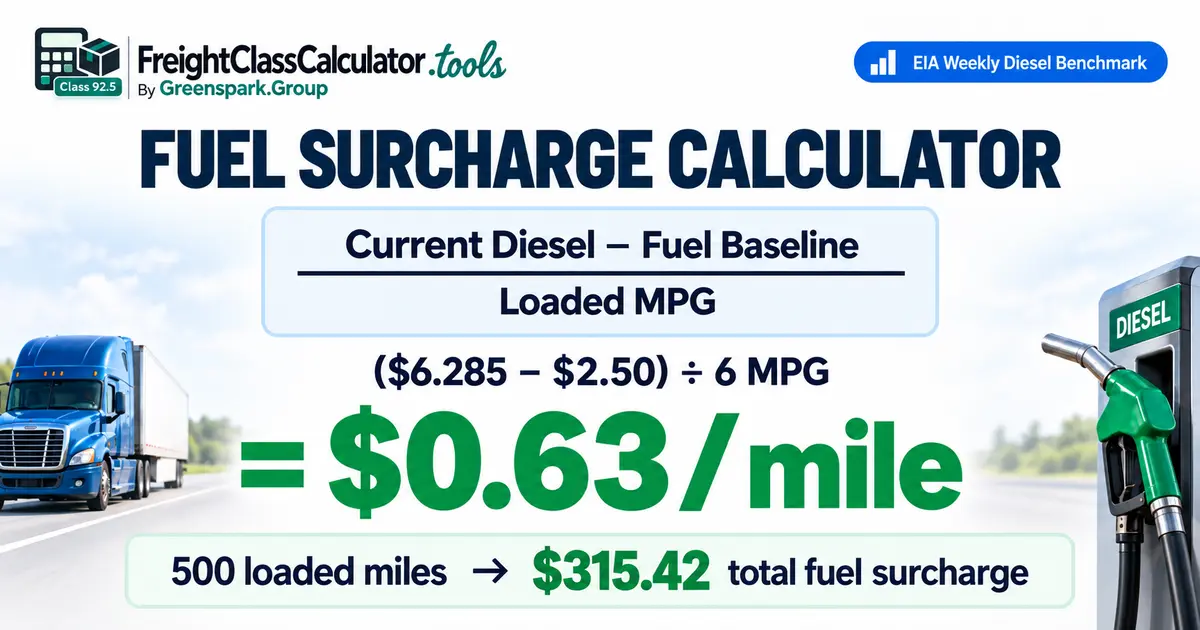
A common truckload fuel surcharge uses the difference between the current diesel price and the agreed fuel baseline. Divide that difference by loaded MPG to get the surcharge per mile. The calculator uses the full per-mile value when calculating the total surcharge, then rounds the displayed numbers for readability. This keeps small rounding differences from adding up over longer routes.
Standard Per-Mile Formula
FSC Rate per Mile =
Current EIA Price − Base Price
Loaded MPG
Total FSC =
FSC Rate per Mile × Loaded Miles
Contract Step Schedule Formula
Steps =
⌊
Current EIA Price − Base Price
Step Increment
⌋
FSC Rate per Mile =
Steps × Rate per Increment
Total FSC =
FSC Rate per Mile × Loaded Miles
Example
Fuel Surcharge Calculation Example
Using the current default example at a $6.382 diesel benchmark, $2.50 fuel baseline, 6.0 loaded MPG, and 500 loaded miles.
Diesel Increase Above Baseline
$3.882/gal
Surcharge Per Mile
$0.6470/mi
Total Surcharge
$323.50
Diesel benchmark
Current EIA / DOE Diesel Price
Many freight contracts refer to the weekly benchmark as the “DOE diesel price” or “DOE fuel index.” The weekly retail on-highway diesel prices are published by the U.S. Energy Information Administration (EIA). Greenspark's fuel surcharge calculator includes the U.S. national average plus the five major Petroleum Administration for Defense Districts (PADDs), so a contract can be modeled against a national or regional benchmark.
Confirm your contract language. A contract may use the most recent published week, the prior week, or another effective-date convention even when the same EIA series is referenced.
Contract input
What Is a Fuel Price Baseline?
The fuel-price baseline—sometimes called a fuel peg—is the diesel price already assumed in the underlying freight rate. The surcharge is designed to address the increase above that baseline, not automatically reimburse the carrier's entire fuel bill. Use the baseline written into the contract or rate agreement rather than choosing a generic number simply because it is common elsewhere.
Different freight conventions
Fuel Surcharge Per Mile vs. LTL Fuel Surcharge Percentage
Truckload and owner-operator agreements often express fuel surcharge as cents per loaded mile. LTL carriers frequently publish a separate percentage schedule that is applied to linehaul charges. Those are different calculation systems. This calculator's default mode is the per-mile MPG formula; the optional contract-step section is for fixed per-mile increments. It does not attempt to reproduce individual carrier LTL tariffs.
Per-Mile FSCUsed by this calculator
Based on the diesel benchmark, fuel baseline, loaded MPG, and loaded miles.
Diesel increase ÷ MPG
Different calculation system
LTL Percentage FSCCarrier schedule
Usually determined from a carrier fuel-surcharge schedule and applied to the linehaul charge.
Schedule % × Linehaul
Using the % of Net Linehaul (LTL) mode. Enter the net linehaul amount and the applicable fuel-surcharge percentage from your carrier tariff, contract, quote, invoice, or fuel-surcharge schedule. The calculator applies the percentage you provide; it does not determine a carrier's FSC percentage or reproduce that carrier's tariff schedule.
What Net Linehaul Means
For this calculation, net linehaul is the linehaul charge after applicable freight discounts and before the fuel surcharge is added. It is not necessarily the original tariff or gross linehaul amount. If your paperwork shows a tariff charge and a discount rather than a net linehaul amount, the optional helper in the LTL mode can calculate the discounted linehaul first.
Shipment dimensions and freight costs: Shipment dimensions and density can influence freight classification and transportation charges. When a fuel surcharge is calculated as a percentage of net linehaul, the resulting freight charge provides the basis for that calculation. To calculate your shipment's volume in cubic meters, use our CBM Calculator.
Net Linehaul =
Tariff Charge × (1 − Discount %)
How to Calculate an LTL Fuel Surcharge (% of Net Linehaul)
Fuel Surcharge =
Net Linehaul × FSC %
Hypothetical example: if net linehaul is $1,284.37 and the applicable FSC is 52.50%, the fuel surcharge is $674.29. Linehaul plus fuel surcharge would be $1,958.66 before any other applicable charges.
Carrier terms govern the billed amount. Fuel-surcharge schedules, minimum charges, discounts, flat or spot rates, rounding rules, and the treatment of accessorial charges can vary by carrier and agreement. Use the values and rules that apply to the specific shipment rather than assuming one carrier's method applies to another.
Freight payment responsibility
Who Pays the Fuel Surcharge?
Calculating a fuel surcharge determines the additional transportation charge, but it does not necessarily establish whether the buyer or seller is responsible for paying it. Freight billing arrangements, the sales agreement, and the agreed delivery terms are other important factors that determine who pays the fuel surcharge.
See our guide to the meaning of FOB and how different shipping terms work in practice.
Freight Planning Calculators
Calculate and Plan Your Freight Shipment
Use these tools to estimate trip fuel expenses and plan freight class, density, pallet space, linear feet, CBM, and hazardous-material classifications.
Truck Fuel Cost Calculator
Use this when you need to estimate the actual diesel cost of a truck trip.
Calculate fuel gallons, trip cost, and cost per mile using distance, MPG, and diesel prices.
Truck Fuel Cost CalculatorFuel Cost Calculator
Use this when you want to estimate fuel expenses for a trip.
Calculate gasoline, diesel, or CNG trip costs using US, India, UK, and metric units.
Fuel Cost CalculatorFreight Class Calculator
Use this when you need an estimated freight class.
Estimate freight class from packaged dimensions, weight, and density.
Freight Class CalculatorFreight Density Calculator
Use this when you only need cubic feet and density.
Calculate shipment volume and pounds per cubic foot without the freight-class workflow.
Freight Density CalculatorPallet Freight Calculator
Use this when you are planning a palletized shipment.
Work with pallet dimensions, shipment weight, density, and pallet configuration.
Pallet Freight CalculatorFreight Linear Feet Calculator
Use this when trailer-space usage is the question.
Estimate how many linear feet your packaged freight occupies inside a trailer.
Freight Linear Feet CalculatorCBM Calculator
Use this when shipment volume needs to be in cubic meters.
Calculate CBM for cartons, pallets, and mixed-product freight dimensions.
CBM CalculatorDOT Hazard Classes
Use this when you need to identify hazardous-material classifications.
Look up DOT hazard classes, UN/NA numbers, placards, and material information.
DOT Hazard ClassesImportant Notes
This calculator provides a planning estimate based on the calculation method and inputs you select. For the Fuel Index / MPG method, results are based on the diesel benchmark, fuel baseline, MPG, miles, and any optional contract-step inputs you enter. For the % of Net Linehaul (LTL) method, results are based on the net linehaul amount and FSC percentage you enter. Actual fuel-surcharge billing depends on your carrier, broker, shipper, or customer agreement, which may specify a different effective week, regional benchmark, rounding rule, step schedule, surcharge percentage, linehaul basis, or surcharge method. Always confirm the applicable contract language before using the result for invoicing or settlement. Deadhead analysis is for cost and recovery planning only and does not mean empty miles are automatically billable as fuel surcharge.