
Incoterms 2020 Cost and Risk Tool
Choose an Incoterms® 2020 rule to examine delivery, carriage costs and risk transfer along the shipping journey. Then review the rule-specific responsibilities and pre-agreement checklist.
New to Incoterms? Explore all 11 Incoterms® 2020 rules.
Interactive Incoterms 2020 Explorer
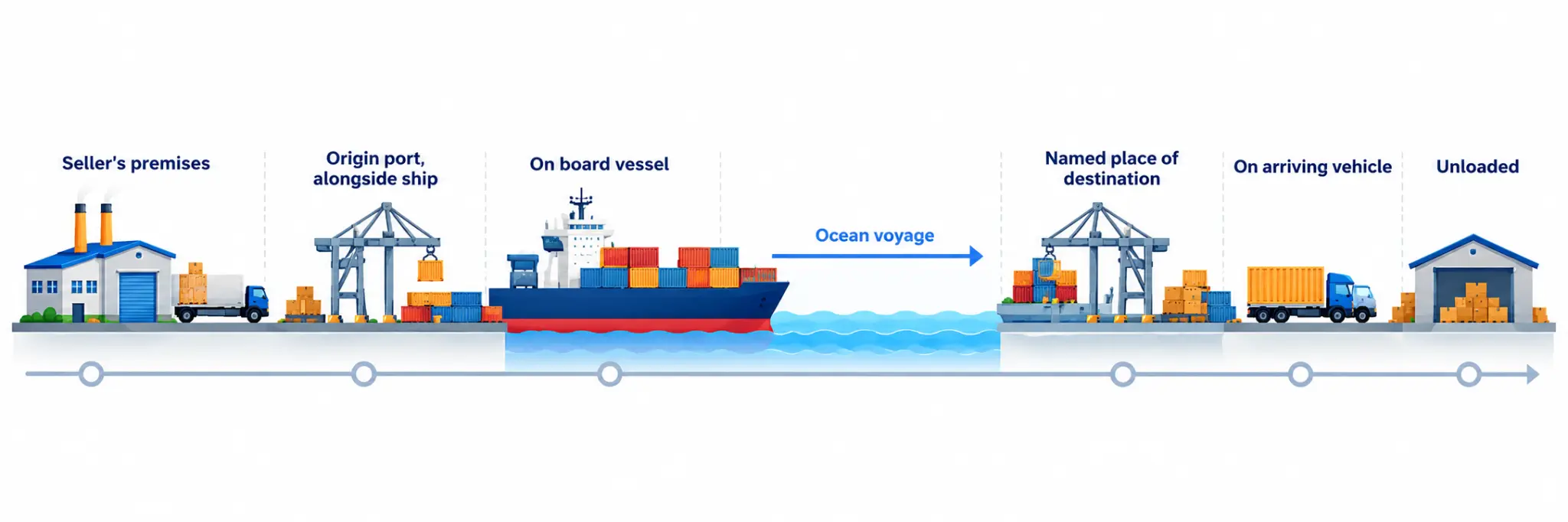
Choose any rule or move the slider to see where the seller pays carriage, where risk changes hands, and what to confirm in your contract.
How to Use the Incoterms Explorer
- 1Choose a transport mode.
Select “Any transport mode” or “Sea & inland waterway.” The second option helps you focus on rules for vessel transport.
- 2Select a rule or explore with the slider.
Choose a rule chip, or move “Seller's responsibility” to explore different responsibility positions. When variations appear, select the specific rule you want.
- 3Locate the two markers.
Blue shows how far the seller pays carriage; green shows where risk passes to the buyer. They do not always stop together.
- 4Read the rule details.
Review delivery, risk, carriage costs, the “Next rule over” options, and the responsibility cards below the journey.
- 5Check before agreeing.
Continue to the rule-specific pre-agreement checklist, mark the questions you reviewed, and copy questions to ask your supplier or forwarder.
The slider is not a freight-price calculator. It changes the selected rule or responsibility position; actual contract terms and charges still need checking.
Understanding Cost, Delivery and Risk
Carriage payment and transfer of risk are different obligations. The seller can pay for transport after the buyer has already taken on transit risk.
The seller pays freight to the named destination port, but risk passes when goods are on board at the port of shipment. CIF also requires the seller to obtain cargo insurance. The named port and carriage contract still matter.
The rule identifies the delivery event or point. Under Incoterms® 2020, risk transfers when delivery under that rule occurs.
The green indicator identifies where the buyer assumes the risk of loss or damage; it is not a statement about ownership.
The blue indicator shows how far the seller's carriage-payment obligation extends. It is not a complete account of customs, insurance, or every destination charge.
Why this matters. Paying freight does not necessarily mean bearing the risk throughout the journey. Check insurance, terminal charges, loading, unloading, and customs obligations separately.
What to Confirm Before Agreeing to an Incoterm
Use these checks alongside the rule-specific checklist below the Explorer.
Write the precise delivery or destination point with the Incoterms® 2020 rule; the city name alone may leave the handover unclear.
Confirm who handles formalities, brokerage, duties and taxes—and whether the responsible party can legally perform them.
Identify when risk passes and whether insurance is mandatory under the selected rule or separately arranged.
Confirm who performs and pays for loading, unloading, and terminal handling at the actual handover points.
Ask what the carriage contract and supplier quote include, and put any agreed changes or exclusions in writing.
Final step. Use the existing “What to check before you agree” checklist for the selected rule. It gives more specific questions to raise with your supplier or forwarder.
SELECT TRANSPORT MODE
Any transport mode
Sea & inland waterway only

Variations at this step
Next rule over
What to check before you agree to FOB
Questions to raise with your supplier or freight forwarder, ideally settled in writing.
Not every question applies to every shipment. Mark the ones that don't fit yours. Each question also says what it rests on: an Incoterms rule, ICC guidance, customs or tax law, or something Incoterms leaves to your contract.