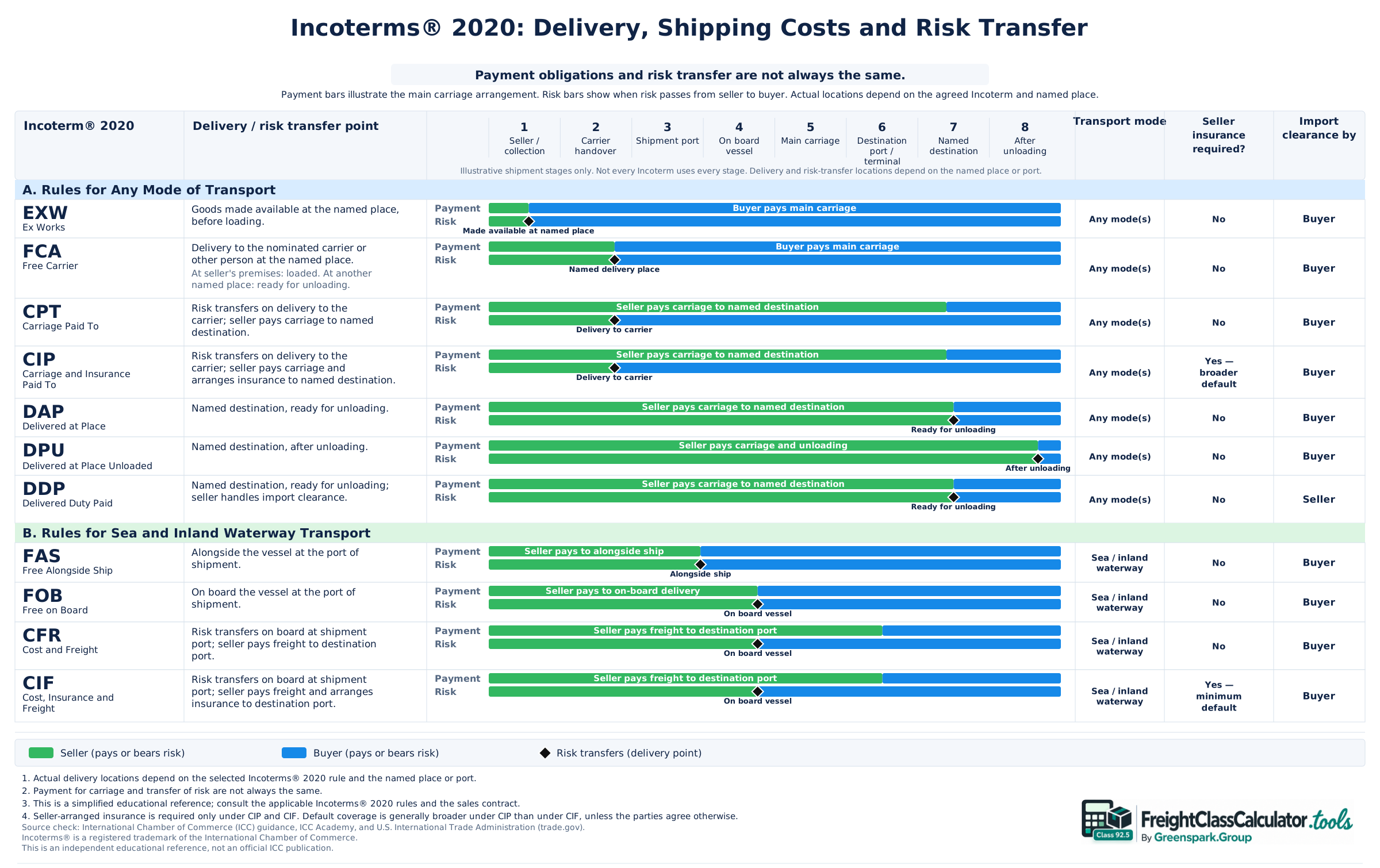
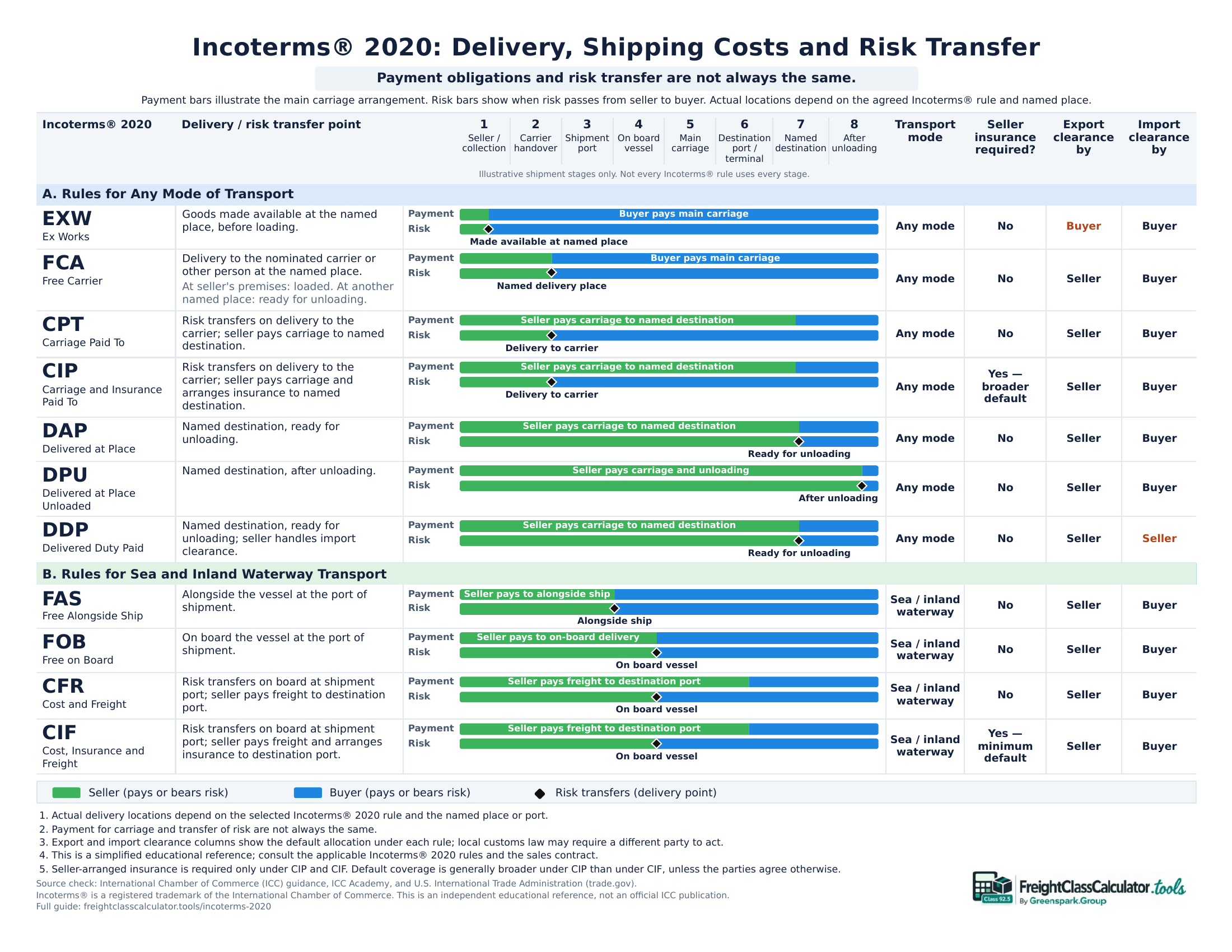
Incoterms 2020 Responsibility Chart
Compare all 11 rules, delivery responsibilities, shipping costs, risk transfer, customs and insurance.

Incoterms® 2020 helps buyers and sellers answer three important shipping questions: Who is responsible for transportation? Who pays the costs? And when does the risk of loss or damage pass from the seller to the buyer.
Incoterms® stands for International Commercial Terms. Incoterms was first introduced in 1936 by the International Chamber of Commerce (ICC). It contains 11 rules that help buyers and sellers agree on delivery responsibilities, transportation costs, customs formalities, and when the risk of loss or damage passes from the seller to the buyer. The agreed rule is normally stated in the sales contract or purchase order and may also appear on commercial invoices and other shipping documents.
Of the 11 Incoterms® 2020 rules, seven can be used with any mode of transport and four are for sea and inland waterway transport. Select a rule below to read its explanation or view the Incoterms 2020 chart.
| Any mode of transport | |
|---|---|
| Sea and inland waterway only |
Example: Consider a shipment traveling from Mumbai to New York. The seller might pay the ocean freight, but that doesn't necessarily mean the seller is responsible if the goods are damaged during the voyage. The Incoterms rule agreed upon in the sales contract determines where that responsibility changes hands.
The ICC began studying international trade terms in the 1920s and published the first Incoterms rules in 1936. Since then, the rules have been revised to reflect changes in shipping and international trade. Here are some key dates and changes:
Source: ICC Incoterms rules history, ICC's 2020 edition announcement, and ICC Netherlands' Incoterms 2030 revision announcement.
Incoterms explain which delivery and shipping responsibilities belong to the buyer and which belong to the seller. They do not replace the sales contract.
| What Incoterms Cover | What Incoterms Do Not Cover |
|---|---|
| Where delivery takes place and when the risk of loss or damage passes to the buyer | When the buyer becomes the legal owner of the goods |
| Which shipping expenses the buyer and seller must pay | The selling price, payment method or payment deadline |
| Who arranges transportation, handles customs and, where required, obtains cargo insurance | What happens if either party breaks the sales contract |
Consider a seller shipping machinery to a buyer in another country. The shipment may involve collection, export customs, inland transportation, ocean or air freight, import customs, and final delivery. Different Incoterms rules determine which responsibilities belong to the buyer and which belong to the seller.
| Shipping responsibility | How Incoterms 2020 works |
|---|---|
| Who arranges and pays for transportation? | Under some rules, the buyer arranges the main journeyThe main part of the shipping journey, such as ocean freight or long-distance trucking. Under some Incoterms rules, the seller pays for this transportation even though the buyer already bears the risk of loss or damage.. Under others, the seller books and pays for shipping to the agreed destination. The exact responsibility depends on the chosen rule and delivery location. |
| When does the risk of loss or damage transfer? | Risk transferFor example, under CPT the buyer bears the risk after the goods are delivered to the carrier, even though the seller pays to transport them farther. identifies the point after which the buyer rather than the seller generally bears the accidental loss or damage to the goods. Under Incoterms® 2020, risk generally passes to the buyer when the seller completes delivery under the chosen rule. That delivery point is not necessarily where the seller stops paying freight.[1] |
| Who handles customs clearance? | Incoterms specify whether the buyer or seller must handle export, import and applicable transit customs proceduresCustoms checks or paperwork required when goods pass through another country on the way to their final destination. Who handles them depends on the Incoterms rule.. Under most rules, the seller clears goods for export and the buyer clears them for import. EXW and DDP are important exceptions. Transit formalities depend on the chosen rule and should be checked separately.[2] |
| Who must obtain cargo insurance? | Only CIP and CIF impose a specific obligation on the seller to arrange cargo insuranceInsurance that helps protect against loss or damage to goods during shipping. Under CIP and CIF, the seller must arrange the insurance required by those rules. under the rules. Parties may still choose insurance under other terms. |
Select any rule in the table below to see its delivery responsibilities, when risk transfers, who pays transportation costs, and whether cargo insurance is required.
Transport: Any mode of transport, including multimodal shipmentsA shipment using two or more transport modes, for example truck and ocean vessel.
What it means: The seller makes the goods available at the named place, commonly its own premises. The buyer generally organizes collection and the onward journey.
When risk transfers: Risk transfers when the seller makes the goods available to the buyer at the named place, before loading them onto the collecting vehicle.
What to know: The buyer normally arranges transport and handles export customs procedures. EXW can be difficult for international shipments if the buyer cannot complete export formalities in the seller’s country. If the seller physically loads the collecting vehicle, that is normally at the buyer’s risk and cost unless otherwise agreed.
Transport: Any mode of transport, including multimodal shipments
What it means: The seller delivers to the carrier or other person nominated by the buyer at a named place.
When risk transfers: If the named place is the seller’s premises, delivery is after loading onto the collecting means of transport. At another named place, delivery occurs when the goods are placed at the carrier’s disposal on the seller’s arriving vehicle, ready for unloading.
What to know: The seller handles export customs clearance where required. The contract must identify the delivery location clearly because it determines how the seller completes delivery.
Transport: Any mode of transport, including multimodal shipments
What it means: The seller contracts and pays for carriage to the named destinationThe place the seller agrees to pay for transportation to. Under CPT, CIP, CFR and CIF, the buyer may take on the shipping risk before the goods reach that place., but the buyer assumes transit risk earlier.
When risk transfers: Risk transfers when the goods are delivered to the carrier under the rule, not simply when they arrive at the paid-to destination.
What to know: The seller may pay for shipping all the way to the destination even though the buyer bears the risk after delivery to the carrier.
Transport: Any mode of transport, including multimodal shipments
What it means: The seller pays for carriage to the named destination and obtains cargo insurance for the buyer’s benefit.
When risk transfers: Risk generally passes at delivery to the carrier, even though the seller pays carriage and obtains insurance to the destination.
What to know: Incoterms® 2020 normally requires the higher Institute Cargo Clauses (A)A type of cargo insurance offering broad protection against loss or damage, but with exclusions. CIP generally requires this level of protection unless the buyer and seller agree otherwise. level of cover or equivalent, subject to the rule and party agreement.
Transport: Any mode of transport, including multimodal shipments
What it means: The seller arranges delivery to the named destination, ready for unloading.
When risk transfers: Risk generally transfers when the goods are placed at the buyer’s disposal on the arriving transport, ready for unloading.
What to know: The buyer normally handles import clearanceThe customs paperwork and procedures needed to bring goods into a country. Under DDP, the seller normally handles this process., duties and unloading. The buyer normally pays unloading costs unless those charges are allocated to the seller under its carriage contract.
Transport: Any mode of transport, including multimodal shipments
What it means: The seller delivers goods after unloading them at the named destination.
When risk transfers: Risk passes after the goods have been unloaded and placed at the buyer’s disposal at the named place.
What to know: Under DPU, which replaced DAT in Incoterms® 2020, the seller must unload the goods at the named destination. Under DAP, the seller delivers them ready for unloading, and the buyer normally unloads them.
Transport: Any mode of transport, including multimodal shipments
What it means: The seller arranges delivery to the named destination and is responsible for import customs clearance and applicable import duties.
When risk transfers: Risk generally transfers when goods are at the buyer’s disposal on the arriving means of transport, ready for unloading.
What to know: DDP may be unsuitable if the seller cannot legally act as the importer or complete customs procedures in the buyer’s country. The seller also bears applicable import taxes such as VAT or GST, which may not be recoverable; any agreed tax exclusion must be clearly recorded in the sales contract.
Transport: Used for shipping by sea or inland waterways
What it means: The seller delivers goods alongside the vessel at the named port of shipment.
When risk transfers: Risk passes when the goods are placed alongside the vessel, subject to the rule’s delivery provisions.
What to know: FAS is for sea and inland waterway shipments. It cannot be used for air, road or rail shipments.
Transport: Used for shipping by sea or inland waterways
What it means: The seller delivers goods on board the vessel at the named port of shipment.
When risk transfers: Risk transfers when the goods are on board the vessel under the rule.
What to know: International FOB under Incoterms® 2020 must not be confused with U.S. domestic FOB Shipping Point or FOB Destination.
For a detailed explanation of international FOB and its differences from U.S. domestic FOB, read our FOB Meaning in Shipping guide.
Transport: Used for shipping by sea or inland waterways
What it means: The seller pays the freight to the named destination port.
When risk transfers: Risk generally transfers when the goods are on board the vessel at the shipment port.
What to know: Freight paid to the destination does not mean the seller bears risk until arrival. The parties should also identify the shipment port and on-board delivery point precisely.
Transport: Used for shipping by sea or inland waterways
What it means: The seller pays freight and obtains required cargo insurance to the named destination port.
When risk transfers: Risk generally transfers when the goods are on board the vessel at the shipment port.
What to know: The default insurance requirement is generally Institute Cargo Clauses (C) or similar, which is more limited than the CIP default. The parties should identify the shipment port and on-board delivery point precisely.
The appropriate rule depends on how the goods will travel, where delivery will take place, and which responsibilities the buyer and seller can manage.
This is an educational decision aid based on ICC Incoterms® 2020 rules and guidance, not a substitute for reviewing your sales contract, local customs law or professional advice. Suggestions are not binding.
Select a rule to compare. These comparisons show where similar rules differ in shipping costs, delivery, customs obligations and the transfer of risk.
Under DAP (Delivered at Place), the seller delivers the goods to the agreed destination, but the buyer handles import customs clearance and pays import duties and taxes. Under DDP (Delivered Duty Paid), the seller also handles import clearance and pays those charges.
| Role / Feature | DAP (Delivered at Place) | DDP (Delivered Duty Paid) |
|---|---|---|
| Who handles import customs? | Handled by the buyer | Handled by the seller |
| Who pays import duties and taxes? | Paid by the buyer | Paid by the seller |
| Who arranges shipping? | Arranged by the seller | Arranged by the seller |
| Who pays shipping costs? | Paid by the seller up to the agreed destination | Paid by the seller up to the agreed destination |
| Who handles export customs? | Handled by the seller | Handled by the seller |
| Who unloads the goods? | Normally unloaded by the buyer; unloading costsUnder DAP and DDP, the buyer normally unloads the goods. However, the seller may have to pay an unloading charge if it is included in the seller’s transportation contract. are normally the buyer’s unless included for the seller under its carriage contract | Normally unloaded by the buyer; unloading costs are normally the buyer’s unless included for the seller under its carriage contract |
| Who bears the shipping risk? | The seller bears the risk until delivery at the agreed destination | The seller bears the risk until delivery at the agreed destination |
| When does risk transfer? | When the goods are available to the buyer on the arriving vehicle, ready for unloading | When the goods are available to the buyer on the arriving vehicle, ready for unloading |
| Is cargo insurance required? | DAP does not require either party to buy cargo insurance | DDP does not require either party to buy cargo insurance |
| What should the buyer consider? | The buyer must be able to clear the goods for import and pay the import charges | The buyer should confirm that the seller can legally complete import clearance and account for import VAT/GSTTaxes charged when goods enter a country. VAT means Value Added Tax; GST means Goods and Services Tax. Whether these taxes can be recovered depends on local tax rules., which may not be recoverable |
| How might the quoted price differ? | Import duties and taxes may be paid separately by the buyer | The seller generally factors import duties and taxes, including applicable import VAT/GST, into the quoted price |
Under DAP (Delivered at Place), the seller arranges shipping to the agreed destination and bears the risk until the goods arrive ready for unloading. Under FCA (Free Carrier), the seller delivers to the buyer's nominated carrier or another nominated person at the agreed location. From that delivery point, the buyer generally arranges the main journey and bears the shipping risk.
| Role / Feature | DAP (Delivered at Place) | FCA (Free Carrier) |
|---|---|---|
| Who arranges the main shipping journey? | Arranged by the seller to the agreed destination | Arranged by the buyer after delivery to the nominated carrier or person |
| Who pays for the main shipping journey? | Paid by the seller to the agreed destination | Paid by the buyer after the agreed delivery point |
| Where does the seller deliver the goods? | At the agreed destination, on the arriving vehicle and ready for unloading | To the buyer's nominated carrier or another nominated person at the agreed location |
| When does risk transfer? | When the goods are available to the buyer at the agreed destination, ready for unloading | When the seller completes delivery to the nominated carrier or person at the agreed location |
| Who bears the risk during the main journey? | Normally borne by the seller until delivery at the agreed destination | Normally borne by the buyer after FCA delivery takes place |
| Who handles export customs? | Handled by the seller where export clearance is required | Handled by the seller where export clearance is required |
| Who handles import customs? | Handled by the buyer | Handled by the buyer |
| Who pays import duties and taxes? | Paid by the buyer | Paid by the buyer |
| Who unloads at the final destination? | Normally unloaded by the buyer; unloading costs are normally the buyer’s unless included for the seller under its carriage contract | Unloading at the final destination is normally arranged by the buyer |
| Is cargo insurance required? | DAP does not require either party to buy cargo insurance | FCA does not require either party to buy cargo insurance |
| Who chooses the carrier for the main journey? | Normally selected by the seller | Normally selected by the buyer |
| What should the buyer consider? | The seller arranges delivery, but the buyer must still handle import clearance and unloading | The buyer must arrange the main journey and bears the risk after FCA delivery; if delivery is away from the seller’s premises, the seller transports the goods to that point at its cost and risk |
| Who loads the goods at the seller's premises under FCA? | Under DAP, the seller arranges loading for its contracted transport; FCA-specific handover requirements do not apply | If FCA delivery takes place at the seller's premises, the seller loads the goods onto the collecting vehicle |
Under DAP (Delivered at Place), the seller arranges and pays for transportation to the agreed destination and bears the risk until delivery there. Under EXW (Ex Works), the seller makes the goods available at an agreed location, usually its factory or warehouse, and the buyer takes responsibility for collection and transportation.
| Role / Feature | DAP (Delivered at Place) | EXW (Ex Works) |
|---|---|---|
| Who arranges shipping? | Arranged by the seller | Arranged by the buyer |
| Who pays shipping costs? | Paid by the seller to the agreed destination | Paid by the buyer from the agreed collection location |
| Where does the seller deliver the goods? | At the agreed destination, on the arriving vehicle and ready for unloading | At the agreed collection location, usually the seller’s factory or warehouse |
| When does risk transfer? | When the goods are available to the buyer at the agreed destination, ready for unloading | When the goods are made available to the buyer at the agreed collection location, before loading |
| Who bears the risk during shipping? | The seller bears the risk until delivery at the agreed destination | The buyer normally bears the risk during the journey after EXW delivery |
| Who loads the goods at collection? | The seller arranges loading for the transportation it provides | Under standard EXW the seller is not required to load the collecting vehicle; risk normally passes before loading. If the seller agrees to load, confirm the loading costs and risk in writing |
| Who handles export customs? | Handled by the seller where export clearance is required | Handled by the buyer, with assistance from the seller where required |
| Who handles import customs? | Handled by the buyer | Handled by the buyer |
| Who pays import duties and taxes? | Paid by the buyer | Paid by the buyer |
| Who unloads the goods at the destination? | Normally unloaded by the buyer; unloading costs are normally the buyer’s unless included for the seller under its carriage contract | Arranged by the buyer |
| Is cargo insurance required? | DAP does not require either party to buy cargo insurance | EXW does not require either party to buy cargo insurance |
| Who chooses the shipping company? | Normally selected by the seller | Normally selected by the buyer |
| What should the buyer consider? | The seller manages transportation, but the buyer must handle import clearance | The buyer must arrange collection and transport and be able to handle export clearance |
Under DAP (Delivered at Place), the seller arranges shipping to the agreed destination and bears the risk until the goods arrive ready for unloading. Under FOB (Free on Board), the seller delivers the goods on board the buyer's nominated vessel at the agreed port of shipment. The buyer then bears the risk of the sea journey and arranges the main transportation.
| Role / Feature | DAP (Delivered at Place) | FOB (Free on Board) |
|---|---|---|
| Where can it be used? | Any mode of transport, including multimodal shipments | Used only for sea and inland waterway shipping |
| Where does the seller deliver the goods? | At the agreed destination, on the arriving vehicle and ready for unloading | On board the vessel at the agreed port of shipment |
| When does risk transfer? | When the goods are available to the buyer at the agreed destination, ready for unloading | When the goods are on board the vessel at the agreed port of shipment |
| Who arranges the main shipping journey? | Arranged by the seller | Arranged by the buyer |
| Who pays for the main shipping journey? | Paid by the seller to the agreed destination | Paid by the buyer from the port of shipment |
| Who bears the risk during the main journey? | Normally borne by the seller until delivery at the agreed destination | Normally borne by the buyer once the goods are on board the vessel |
| Who transports the goods to the departure port? | Arranged by the seller as part of the agreed transportation, where shipping involves a port | Arranged by the seller up to the port of shipment |
| Who loads the goods onto the ship? | Handled under the seller’s transportation arrangements, if shipping involves a vessel | The seller must deliver the goods on board the vessel |
| Who handles export customs? | Handled by the seller where export clearance is required | Handled by the seller where export clearance is required |
| Who handles import customs? | Handled by the buyer | Handled by the buyer |
| Who pays import duties and taxes? | Paid by the buyer | Paid by the buyer |
| Who arranges delivery after the ship arrives? | Arranged by the seller up to the agreed destination, if the shipment travels by sea | Arranged by the buyer |
| Who unloads at the final destination? | Normally unloaded by the buyer; unloading costs are normally the buyer’s unless included for the seller under its carriage contract | Arranged by the buyer |
| Is cargo insurance required? | DAP does not require either party to buy cargo insurance | FOB does not require either party to buy cargo insurance |
| Who chooses the shipping company? | Normally selected by the seller | The buyer nominates the vessel for the sea journey |
| What should the buyer consider? | The seller manages transportation to the agreed destination, but the buyer handles import clearance | The buyer must arrange the sea journey and onward delivery and bears risk once the goods are on board |
Under DAP (Delivered at Place), the seller delivers goods to the agreed destination, ready for unloading, and the buyer is responsible for unloading them. Under DPU (Delivered at Place Unloaded), the seller must also unload the goods before delivery is complete.
| Role / Feature | DAP (Delivered at Place) | DPU (Delivered at Place Unloaded) |
|---|---|---|
| Who unloads the goods? | Unloading is the buyer’s responsibility | Unloading is the seller’s responsibility |
| When does risk transfer? | When the goods are available to the buyer at the agreed destination, ready for unloading | After the goods have been unloaded and made available to the buyer at the agreed destination |
| Who bears the risk during unloading? | Normally borne by the buyer | Borne by the seller until unloading is complete |
| Who arranges shipping? | Arranged by the seller | Arranged by the seller |
| Who pays shipping costs? | Paid by the seller to the agreed destination | Paid by the seller to the agreed destination, including the required unloading |
| Where does the seller deliver the goods? | At the agreed destination, on the arriving vehicle and ready for unloading | At the agreed destination, after unloading the goods |
| Who provides unloading equipment? | Normally arranged by the buyer | The seller must arrange the equipment or services needed to unload |
| Who handles export customs? | Handled by the seller where export clearance is required | Handled by the seller where export clearance is required |
| Who handles import customs? | Handled by the buyer | Handled by the buyer |
| Who pays import duties and taxes? | Paid by the buyer | Paid by the buyer |
| Is cargo insurance required? | DAP does not require either party to buy cargo insurance | DPU does not require either party to buy cargo insurance |
| Where can it be used? | Any mode of transport, including multimodal shipments | Any mode of transport, including multimodal shipments |
| What should the buyer consider? | The buyer must be prepared to unload the goods at the agreed destination | The buyer should confirm that the seller can safely arrange unloading at the agreed destination |
Make sure the seller can unload under DPUDPU requires the seller to unload the goods at the agreed destination. Before choosing DPU, confirm that the seller can arrange the necessary equipment, staff or unloading services. If the buyer will handle unloading, DAP is usually the more appropriate rule. |
||
Under FCA (Free Carrier), the seller delivers goods to the buyer’s nominated carrier or person at an agreed location. Under FOB (Free on Board), the seller delivers goods on board a vessel at the agreed port of shipment. The main differences are where delivery takes place, when risk transfers, and which types of transport can be used.
| Role / Feature | FCA (Free Carrier) | FOB (Free on Board) |
|---|---|---|
| Where can it be used? | Any mode of transport, including multimodal shipments | Used only for sea and inland waterway shipping |
| Where does the seller deliver the goods? | To the buyer’s nominated carrier or another nominated person at the agreed place | On board the vessel at the agreed port of shipment |
| When does risk transfer? | When the seller completes delivery at the agreed FCA place | When the goods are on board the vessel at the agreed port of shipment |
| Who arranges the main shipping journey? | Normally arranged by the buyer after FCA delivery | Arranged by the buyer for the sea journey |
| Who pays for the main shipping journey? | Paid by the buyer after the FCA delivery point | Paid by the buyer for shipping from the port of shipment |
| Who bears the risk during the main journey? | Normally borne by the buyer after FCA delivery | Borne by the buyer once the goods are on board the vessel |
| Who handles export customs? | Handled by the seller where export clearance is required | Handled by the seller where export clearance is required |
| Who handles import customs? | Handled by the buyer | Handled by the buyer |
| Who pays import duties and taxes? | Paid by the buyer | Paid by the buyer |
| Who loads the goods at the seller’s premises? | The seller loads the goods onto the buyer’s collecting vehicle when FCA delivery is at the seller’s premises | FOB delivery takes place on board the ship, not at the seller’s premises |
| Must the seller unload at the agreed delivery point? | At a place other than the seller’s premises, delivery is completed with the goods on the arriving vehicle, ready for unloading | The seller must deliver the goods on board the vessel, rather than at a land-based handover point |
| Who chooses the main carrier? | Normally selected by the buyer | The buyer nominates the vessel |
| Is cargo insurance required? | FCA does not require either party to buy cargo insurance | FOB does not require either party to buy cargo insurance |
| Is it suitable for container shipping? | Often better suited when the seller hands over containers at a terminal before vessel loading | Generally unsuitable when the seller hands over containers before they are loaded on board |
| What about an on-board bill of lading? | If the parties agree, the buyer must instruct its carrier to issue an on-board bill of ladingA shipping document issued by the carrier confirming receipt or shipment of goods. Under FCA, the buyer and seller can agree on an arrangement for obtaining a bill of lading showing the goods were loaded on board. to the seller after loading. The carrier is not automatically bound to comply; confirm that it will issue the document in advance | The seller provides the agreed proof of on-board delivery; the transport document depends on the shipping arrangements |
| What should the buyer consider? | The buyer arranges onward shipping and should identify the precise FCA delivery point | The buyer arranges sea freight and bears the risk once the goods are on board |
Choosing FCA for container shipmentsFor container shipments delivered to a terminal before vessel loading, FCA is often more appropriate than FOB because the seller may hand over the container before it is loaded on board. |
||
What if a container is damaged before it is loaded?Imagine a container is handed over to the buyer’s nominated carrier at a port terminal on Monday, but it is not loaded onto the ship until Wednesday. Under FCA at that terminal, risk normally passes to the buyer when delivery is completed on Monday. Under FOB, risk normally remains with the seller until the container is on board on Wednesday. This is one reason FCA often fits container-terminal handovers better. |
||
Under FCA (Free Carrier), the seller handles export customs clearance and delivers the goods to the buyer’s nominated carrier or person at an agreed location. Under EXW (Ex Works), the seller makes the goods available for collection, while the buyer normally handles loading, export clearance and transportation.
| Role / Feature | FCA (Free Carrier) | EXW (Ex Works) |
|---|---|---|
| Who handles export customs? | Handled by the seller where export clearance is required | Handled by the buyer, with assistance from the seller where required |
| Who loads the goods at the seller’s premises? | The seller loads the buyer’s collecting vehicle | Under standard EXW the seller is not required to load the collecting vehicle; risk normally passes before loading. If the seller agrees to load, confirm the loading costs and risk in writing |
| When does risk transfer? | When the seller completes delivery to the nominated carrier or person at the agreed location | When the goods are made available at the agreed collection location, before loading |
| Who arranges the main shipping journey? | Normally arranged by the buyer after FCA delivery | Arranged by the buyer from the collection location |
| Who pays for the main shipping journey? | Paid by the buyer after the FCA delivery point | Paid by the buyer from the agreed collection location |
| Where can the seller deliver the goods? | At the seller’s premises or another agreed location, such as a terminal | At the seller’s premises or another agreed collection location |
| What happens if delivery is at the seller’s premises? | Under FCA, the seller completes delivery after loading the goods onto the buyer’s collecting vehicle | Under EXW, the seller makes the goods available before loading |
| What happens if FCA delivery is at another location? | The seller delivers to the nominated carrier or person on the arriving vehicle, ready for unloading | FCA delivery rules do not apply; the buyer collects the goods at the agreed EXW location |
| Who unloads the seller’s vehicle at another FCA delivery location? | Unloading is normally arranged by the buyer or its nominated carrier | This is not an FCA delivery; collection and onward handling are the buyer’s responsibility |
| Who bears the risk during loading at the seller’s premises? | The seller bears the risk until FCA delivery is completed after loading | The buyer bears the risk after EXW delivery, including during loading |
| Who handles import customs? | Handled by the buyer | Handled by the buyer |
| Who pays import duties and taxes? | Paid by the buyer | Paid by the buyer |
| Is cargo insurance required? | FCA does not require either party to buy cargo insurance | EXW does not require either party to buy cargo insurance |
| Where can it be used? | Any mode of transport, including multimodal shipments | Any mode of transport, including multimodal shipments |
| Is it suitable for international shipments? | Often more practical when export customs clearance is required | Can create difficulties if the buyer cannot complete export procedures in the seller’s country |
| What should the buyer consider? | The seller handles export clearance and completes delivery at the agreed FCA point | The buyer must arrange collection and transportation and be able to manage export formalities |
Why FCA is often better than EXW for international shippingUnder EXW, the buyer is responsible for export customs clearance, even when the goods are leaving another country. That can be difficult if the buyer cannot legally complete export procedures there. Under FCA, the seller handles export clearance, making it a more practical option for many cross-border shipments. |
||
Under FCA (Free Carrier), the seller delivers goods to the buyer’s nominated carrier or person at an agreed location, and the buyer normally arranges the main shipping journey. Under DDP (Delivered Duty Paid), the seller arranges delivery to the agreed destination, handles import customs clearance, and pays the applicable import duties and taxes.
| Role / Feature | FCA (Free Carrier) | DDP (Delivered Duty Paid) |
|---|---|---|
| Who arranges the main shipping journey? | Arranged by the buyer after FCA delivery | Arranged by the seller |
| Who handles import customs? | Handled by the buyer | Handled by the seller |
| Who pays import duties and taxes? | Paid by the buyer | Paid by the seller under the standard DDP rule |
| Who pays for the main shipping journey? | Paid by the buyer after FCA delivery | Paid by the seller to the agreed destination |
| Where does the seller deliver the goods? | To the buyer’s nominated carrier or person at the agreed location | At the agreed destination, on the arriving vehicle, ready for unloading |
| When does risk transfer? | When the seller completes delivery at the agreed FCA location | When the import-cleared goods are made available at the agreed destination, ready for unloading |
| Who bears the risk during the main journey? | Normally the buyer after FCA delivery | The seller until delivery at the agreed destination |
| Who handles export customs? | Handled by the seller where export clearance is required | Handled by the seller where export clearance is required |
| Who arranges transportation to the delivery point? | The seller arranges transport to the FCA delivery point if it is away from the seller’s premises | The seller arranges transport to the agreed destination |
| Who loads the goods at the seller’s premises? | The seller loads the buyer’s collecting vehicle if FCA delivery occurs there | The seller arranges loading for the transportation it provides |
| Who unloads at the final destination? | Normally arranged by the buyer | Normally the buyer’s responsibility |
| Who chooses the shipping company? | Normally selected by the buyer for the main journey | Normally selected by the seller |
| Is cargo insurance required? | FCA does not require either party to buy cargo insurance | DDP does not require either party to buy cargo insurance |
| Where can it be used? | Any mode of transport, including multimodal shipments | Any mode of transport, including multimodal shipments |
| How might the quoted price differ? | The buyer normally pays main freight and import charges separately | The seller generally includes expected freight, customs and import charges in its quoted price |
| What should the buyer consider? | The buyer must arrange onward transport, handle import customs and bear risk after FCA delivery | The buyer should confirm the seller can legally complete import customs clearance |
Can the seller legally handle import customs under DDP?Under DDP, the seller must complete import customs clearance and pay the applicable duties and taxes. However, some countries restrict foreign sellers from carrying out these procedures. Before agreeing to DDP, confirm that the seller can legally complete import clearance in the destination country. If the buyer will handle import customs instead, DAP may be more appropriate. |
||
Under CPT (Carriage Paid To), the seller pays for transportation to an agreed destination, but risk transfers when the goods are delivered to the carrier. Under CFR (Cost and Freight), the seller pays freight to an agreed destination port, but risk transfers when the goods are on board the vessel at the port of shipment. CPT can be used with any transport mode, while CFR is limited to sea and inland waterway shipping.
| Role / Feature | CPT (Carriage Paid To) | CFR (Cost and Freight) |
|---|---|---|
| Where can it be used? | Any mode of transport, including multimodal shipments | Used only for sea and inland waterway shipping |
| When does risk transfer? | When the goods are delivered to the carrier at the agreed delivery point; this is normally the first carrier unless the parties agree otherwise | When the goods are on board the vessel at the port of shipment |
| Where does the seller deliver the goods? | To the carrier contracted by the seller at the agreed delivery point | On board the vessel at the port of shipment |
| Who arranges the main shipping journey? | Arranged by the seller | Arranged by the seller |
| Who pays for the main shipping journey? | Paid by the seller to the agreed destination | Paid by the seller to the agreed destination port |
| Where can the seller pay to transport the goods? | To an agreed destination, such as a warehouse, airport or terminal | To the agreed destination port |
| Who bears the risk during the main journey? | Normally the buyer after delivery to the carrier | The buyer once the goods are on board the vessel |
| Who handles export customs? | Handled by the seller where export clearance is required | Handled by the seller where export clearance is required |
| Who handles import customs? | Handled by the buyer | Handled by the buyer |
| Who pays import duties and taxes? | Paid by the buyer | Paid by the buyer |
| Who pays unloading charges at the destination? | Paid by the seller if included as the seller’s responsibility under the carriage contract; otherwise normally paid by the buyer | Paid by the seller if included as the seller’s responsibility under the carriage contract; otherwise normally paid by the buyer |
| Is cargo insurance required? | CPT does not require either party to buy cargo insurance | CFR does not require either party to buy cargo insurance |
| Can it be used for container shipments? | Often appropriate when goods are handed to a carrier at a container terminal before vessel loading | Generally less appropriate when goods are handed over before being loaded on board |
| Who arranges delivery beyond the agreed destination? | Normally arranged by the buyer if transportation beyond that point is needed | Normally arranged by the buyer from the destination port |
| What should the buyer consider? | The seller pays transportation to the agreed destination, but the buyer bears risk after carrier delivery | The seller pays freight to the destination port, but the buyer bears risk once the goods are on board |
What if the goods are damaged before reaching the destination?Suppose a seller pays to ship goods overseas, but the cargo is damaged during the journey. Under CPT, the buyer normally bears the risk once the goods have been delivered to the carrier at the agreed delivery point. Under CFR, the buyer normally bears the risk once the goods are on board the vessel at the shipment port. In both cases, the seller may still be paying the freight even though the buyer bears the shipping risk. |
||
Under CIP (Carriage and Insurance Paid To), the seller pays for transportation and cargo insurance to the agreed destination. Under CIF (Cost, Insurance and Freight), the seller pays for transportation and insurance to the agreed destination port. The main differences are the types of transportation allowed, where risk passes to the buyer, and how much insurance protection the seller must arrange.
| Role / Feature | CIP (Carriage and Insurance Paid To) | CIF (Cost, Insurance and Freight) |
|---|---|---|
| Where can it be used? | Any mode of transport, including multimodal shipments | Used only for sea and inland waterway shipping |
| When does risk transfer? | When goods are delivered to the carrier at the agreed delivery point; normally the first carrier if several are involved and no different point is agreed | When goods are on board the vessel at the shipment port |
| What insurance coverage must the seller obtain? | Normally Institute Cargo Clauses (A) or similar coverage | Normally Institute Cargo Clauses (C) or similar coverage |
| Which rule provides broader standard insurance coverage? | CIP requires broader default protection, subject to exclusions | CIF requires more limited default protection against specified risks |
| What is the minimum insured amount? | Normally at least 110% of the contract price | Normally at least 110% of the contract price |
| Who arranges cargo insurance? | Arranged by the seller for the buyer’s benefit | Arranged by the seller for the buyer’s benefit |
| Who pays for cargo insurance? | Paid by the seller | Paid by the seller |
| Can the buyer and seller agree on different insurance coverage? | Yes, including a lower level of coverage if expressly agreed | Yes, including broader coverage if expressly agreed |
| Where does the seller deliver the goods? | To the carrier contracted by the seller at the agreed delivery point | On board the vessel at the agreed port of shipment |
| Who arranges shipping? | Arranged by the seller | Arranged by the seller |
| Who pays for shipping? | Paid by the seller to the agreed destination | Paid by the seller to the agreed destination port |
| Who bears the risk during the main journey? | Normally the buyer after delivery to the carrier | The buyer after the goods are on board the vessel |
| Who handles export customs? | Handled by the seller | Handled by the seller |
| Who handles import customs? | Handled by the buyer | Handled by the buyer |
| Who pays import duties and taxes? | Paid by the buyer | Paid by the buyer |
| Is it suitable for container shipments? | Often appropriate when containers are handed over at terminals before vessel loading | Generally less appropriate when containers are handed over before being loaded onto the vessel |
| Who arranges transportation beyond the agreed destination? | Normally the buyer, where further transportation is needed | Normally the buyer from the destination port |
| What should the buyer consider? | Risk transfers early despite the seller paying for transportation and broader insurance | The seller provides more limited default insurance, and risk transfers once the goods are on board |
Both CIP and CIF include insurance, but the protection is differentUnder Incoterms 2020, CIP normally requires broader Institute Cargo Clauses (A) coverage, while CIF normally requires the more limited Institute Cargo Clauses (C) coverage. Both generally require insurance for at least 110% of the contract price. Before agreeing to either rule, check the actual insurance policy, its exclusions, and whether additional protection is needed. |
||
Under CPT (Carriage Paid To), the seller pays for transportation to the agreed destination, but the buyer bears the shipping risk once the goods are delivered to the carrier. Under DDP (Delivered Duty Paid), the seller arranges transportation, handles import customs, pays import duties and taxes, and bears the risk until the goods reach the agreed destination, ready for unloading.
| Role / Feature | CPT (Carriage Paid To) | DDP (Delivered Duty Paid) |
|---|---|---|
| When does risk transfer? | When the goods are delivered to the carrier at the agreed delivery point, normally the first carrier unless another point is agreed | When the imported goods are available to the buyer at the agreed destination, ready for unloading |
| Who handles import customs? | Handled by the buyer | Handled by the seller |
| Who pays import duties and taxes? | Paid by the buyer | Paid by the seller |
| Who bears the risk during the main journey? | Normally the buyer after delivery to the carrier | The seller until delivery at the agreed destination |
| Who arranges shipping? | Arranged by the seller | Arranged by the seller |
| Who pays shipping costs? | Paid by the seller to the agreed destination | Paid by the seller to the agreed destination |
| Where does the seller deliver the goods? | To the carrier contracted by the seller at the agreed delivery point | At the agreed destination, on the arriving vehicle, ready for unloading |
| Who handles export customs? | Handled by the seller | Handled by the seller |
| Who chooses the shipping company? | Normally selected by the seller | Normally selected by the seller |
| Who pays unloading charges at the destination? | The seller pays if the carriage contract makes these charges the seller's responsibility; otherwise normally the buyer | Normally the buyer, unless unloading charges are the seller's responsibility under the carriage contract |
| Who unloads the goods at the final destination? | Normally arranged by the buyer | Normally arranged by the buyer |
| Is cargo insurance required? | CPT does not require either party to buy cargo insurance | DDP does not require either party to buy cargo insurance |
| Where can it be used? | Any mode of transport, including multimodal shipments | Any mode of transport, including multimodal shipments |
| How might the quoted price differ? | The buyer normally pays import duties and taxes separately | The seller generally includes expected import charges in the quoted price |
| What should the buyer consider? | The seller pays for transportation, but the buyer bears shipping risk after carrier delivery and handles import customs | The seller bears risk until destination delivery, but must be able to complete import clearance legally |
The seller pays the freight, but who bears the risk?Imagine a seller pays to ship machinery from Germany to a buyer's warehouse in the United States. The machinery is damaged during the ocean journey. Under CPT, the buyer normally bears the risk because the goods have already been delivered to the carrier. Under DDP, the seller normally bears that risk because delivery at the agreed destination has not yet occurred. Both sellers pay for transportation, but the risk belongs to different parties during the journey. |
||
Under CIP (Carriage and Insurance Paid To), the seller pays for transportation and cargo insurance to the agreed destination, but the buyer bears the shipping risk once the goods are delivered to the carrier. Under DAP (Delivered at Place), the seller arranges and pays for shipping and bears the risk until the goods arrive at the agreed destination, ready for unloading. DAP does not require either party to purchase cargo insurance.
| Role / Feature | CIP (Carriage and Insurance Paid To) | DAP (Delivered at Place) |
|---|---|---|
| When does risk transfer? | When goods are delivered to the carrier at the agreed delivery point, normally the first carrier unless another point is agreed | When goods are available to the buyer at the agreed destination, ready for unloading |
| Who must arrange cargo insurance? | The seller must arrange insurance for the buyer’s benefit | Neither party is required to obtain insurance under DAP |
| What insurance coverage is required? | Normally Institute Cargo Clauses (A) or equivalent, subject to agreed changes | No specified coverage is required under DAP |
| What is the required insured amount? | Normally at least 110% of the contract price | No minimum amount is specified under DAP |
| Who bears the risk during the main journey? | Normally the buyer after delivery to the carrier | The seller until delivery at the agreed destination |
| Who pays for shipping? | Paid by the seller to the agreed destination | Paid by the seller to the agreed destination |
| Who arranges shipping? | Arranged by the seller | Arranged by the seller |
| Where does the seller deliver the goods? | To the carrier contracted by the seller at the agreed delivery point | At the agreed destination, on the arriving vehicle, ready for unloading |
| Who handles export customs? | Handled by the seller | Handled by the seller |
| Who handles import customs? | Handled by the buyer | Handled by the buyer |
| Who pays import duties and taxes? | Paid by the buyer | Paid by the buyer |
| Who unloads the goods at the destination? | Normally arranged by the buyer, subject to the agreed transport arrangements | Normally unloaded by the buyer; unloading costs are normally the buyer’s unless included for the seller under its carriage contract |
| Who pays unloading charges at the destination? | The seller pays if responsible for those charges under the carriage contract; otherwise normally the buyer | Normally the buyer, unless the seller is responsible for those charges under the carriage contract |
| Where can it be used? | Any mode of transport, including multimodal shipments | Any mode of transport, including multimodal shipments |
| Can it be used for container shipments? | Yes, including multimodal container transportation | Yes, including multimodal container transportation |
| What should the buyer consider? | The buyer bears risk after carrier delivery but benefits from insurance arranged by the seller | The seller bears transit risk until delivery. DAP does not require seller-arranged cargo insurance; the buyer should consider cover for its own risk from delivery, including unloading |
What happens if the goods are damaged during shipping?Imagine a seller ships machinery from Germany to a warehouse in the United States. The goods are damaged during the ocean journey. Under CIP, the buyer normally bears the risk after the goods have been delivered to the carrier, but the seller must arrange cargo insurance for the buyer's benefit. Under DAP, the seller normally bears that risk because the goods have not yet reached the agreed delivery destination. The important difference: CIP provides required insurance against the buyer's transit risk, while DAP keeps the transit risk with the seller until destination delivery. |
||
Under CIP (Carriage and Insurance Paid To), the seller pays for shipping and cargo insurance to the agreed destination, but the buyer bears the shipping risk after delivery to the carrier. Under DDP (Delivered Duty Paid), the seller arranges transportation, handles import customs, pays import duties and taxes, and bears the risk until the goods reach the agreed destination, ready for unloading.
| Role / Feature | CIP (Carriage and Insurance Paid To) | DDP (Delivered Duty Paid) |
|---|---|---|
| When does risk transfer? | When goods are delivered to the carrier at the agreed delivery point, normally the first carrier unless another point is agreed | When the imported goods are available to the buyer at the agreed destination, ready for unloading |
| Who must arrange cargo insurance? | The seller must arrange insurance for the buyer’s benefit | Neither party is required to obtain cargo insurance under DDP |
| Who handles import customs? | Handled by the buyer | Handled by the seller |
| Who pays import duties and taxes? | Paid by the buyer | Paid by the seller |
| What insurance coverage is required? | Normally Institute Cargo Clauses (A) or similar coverage, subject to agreed changes | No specific insurance coverage is required under DDP |
| What is the required insured amount? | Normally at least 110% of the contract price | No minimum insurance amount is specified under DDP |
| Who bears the risk during shipping? | Normally the buyer after delivery to the carrier | The seller until delivery at the agreed destination |
| Who arranges shipping? | Arranged by the seller | Arranged by the seller |
| Who pays shipping costs? | Paid by the seller to the agreed destination | Paid by the seller to the agreed destination |
| Where does the seller deliver the goods? | To the carrier contracted by the seller at the agreed delivery point | At the agreed destination, on the arriving vehicle, cleared for import and ready for unloading |
| Who handles export customs? | Handled by the seller | Handled by the seller |
| Who chooses the shipping company? | Normally selected by the seller | Normally selected by the seller |
| Who unloads at the final destination? | Normally arranged by the buyer, subject to the transport arrangements | Normally unloaded by the buyer; unloading costs are normally the buyer’s unless included for the seller under its carriage contract |
| Who pays unloading charges at the destination? | The seller pays if responsible under the carriage contract; otherwise normally the buyer | Normally the buyer, unless the seller is responsible under the carriage contract |
| Where can it be used? | Any mode of transport, including multimodal shipments | Any mode of transport, including multimodal shipments |
| Can it be used for container shipments? | Yes, including multimodal container transportation | Yes, including multimodal container transportation |
| How might the quoted price differ? | The buyer normally pays import duties and taxes separately | The seller generally includes expected import duties and taxes in the quoted price |
| What should the buyer consider? | The buyer bears transit risk after carrier delivery but receives insurance arranged by the seller | The seller bears risk until delivery, but must be able to legally complete import customs clearance |
Insurance does not determine who bears the shipping riskUnder CIP, the seller must arrange cargo insurance for the buyer’s benefit, but the buyer normally bears the risk once the goods are delivered to the carrier. Under DDP, the seller is not required to purchase cargo insurance, but still bears the risk until the goods are delivered at the agreed destination. The important lesson: Having insurance and being responsible for shipping damage are not the same thing. Insurance provides financial protection against covered losses; the Incoterms rule determines which party bears the risk. |
||
Under CPT (Carriage Paid To) and CIP (Carriage and Insurance Paid To), the seller arranges and pays for transportation to an agreed destination. Under both rules, shipping risk normally transfers to the buyer when the goods are delivered to the carrier. The main difference is insurance: CIP requires the seller to obtain cargo insurance for the buyer’s benefit, while CPT does not.
| Role / Feature | CPT (Carriage Paid To) | CIP (Carriage and Insurance Paid To) |
|---|---|---|
| Who must arrange cargo insurance? | Neither party is required to buy insurance under CPT | The seller must arrange insurance for the buyer’s benefit |
| What insurance coverage is required? | No specific coverage is required under CPT | Normally Institute Cargo Clauses (A) or similar coverage, subject to agreed changes |
| What is the minimum insured amount? | No minimum insurance amount is specified under CPT | Normally at least 110% of the contract price |
| Who pays for cargo insurance? | The buyer normally pays if it chooses to insure the shipment | The seller pays for the required insurance |
| Who provides the insurance certificate? | No insurance certificate is required from the seller under CPT | The seller must provide the required insurance document so the buyer or other entitled party can claim under the policy |
| When does risk transfer? | When goods are delivered to the carrier at the agreed delivery point, normally the first carrier unless another point is agreed | At the same delivery point as CPT |
| Who bears the risk during the main journey? | Normally the buyer after delivery to the carrier | Normally the buyer after delivery to the carrier |
| Where does the seller deliver the goods? | To the carrier contracted by the seller at the agreed delivery point | To the carrier contracted by the seller at the agreed delivery point |
| Who arranges shipping? | Arranged by the seller | Arranged by the seller |
| Who pays shipping costs? | Paid by the seller to the agreed destination | Paid by the seller to the agreed destination |
| Who handles export customs? | Handled by the seller | Handled by the seller |
| Who handles import customs? | Handled by the buyer | Handled by the buyer |
| Who pays import duties and taxes? | Paid by the buyer | Paid by the buyer |
| Who handles customs procedures in countries the goods pass through? | Normally handled by the buyer where transit customs procedures are required | Normally handled by the buyer where transit customs procedures are required |
| Who is responsible for transportation security requirements? | The seller fulfills transport-related security requirements allocated to it under the rule and its carriage arrangements; export, transit and import formalities must be considered separately | The seller fulfills transport-related security requirements allocated to it under the rule and its carriage arrangements; export, transit and import formalities must be considered separately |
| Who arranges onward transportation beyond the agreed destination? | Normally the buyer, if further transportation is needed | Normally the buyer, if further transportation is needed |
| Where can it be used? | Any mode of transport, including multimodal shipments | Any mode of transport, including multimodal shipments |
| Can it be used for container shipments? | Yes, including multimodal container transportation | Yes, including multimodal container transportation |
| What should the buyer consider? | The buyer bears transit risk and should decide whether to arrange its own cargo insurance | The buyer receives seller-arranged insurance but should review the coverage, exclusions and claims documents |
Does CIP insurance cover every kind of shipping loss?No. CIP normally requires broader cargo insurance under Institute Cargo Clauses (A), but the policy still has exclusions and conditions. Before shipping under CIP, the buyer should check the insurance certificate, covered risks, exclusions, insured amount and claims procedure. Under CPT, the buyer should decide whether to arrange cargo insurance independently because the seller is not required to provide it. |
||
View, enlarge, or download these Incoterms 2020 reference resources for printing and sharing.
Compare all 11 rules, delivery responsibilities, shipping costs, risk transfer, customs and insurance.
A printable 4-page guide covering all 11 Incoterms® 2020 rules, rule selection, key differences, shipping costs, risk transfer and a practical checklist.
Quick answers to common questions about choosing Incoterms, shipping responsibilities, and the 2020 rules.
The buyer and seller agree on an Incoterms® rule in their sales contract; the transport company does not automatically assign one. They should consider who arranges carriage, where delivery and risk transfer occur, who completes customs procedures, whether insurance is required and the precise named place or port. Write the chosen rule, place or port and edition in the agreement, for example: FCA [named place], Incoterms® 2020.
Incoterms® rules are not automatically mandatory for every sales contract. They apply when the parties incorporate an agreed rule into their contract or when otherwise made applicable under relevant law or trade practice. They do not replace the full sales agreement and do not by themselves govern ownership transfer, payment deadlines or remedies for breach.
DAP and DDP can be used when the seller is to arrange carriage to a named door, warehouse or other destination, with goods made available ready for unloading. DPU also reaches a named destination but requires the seller to unload. Under DAP and DPU the buyer handles import clearance; under DDP the seller does. The precise delivery address and any unloading arrangements should be agreed.
Not exactly. Incoterms® allocate delivery obligations, transportation costs and risk of loss or damage between buyer and seller. Freight terms such as “freight prepaid,” “freight collect” or “prepay and add” generally describe how the carrier’s freight bill is charged or reimbursed. A freight billing instruction does not, by itself, establish an Incoterms® rule or the point of risk transfer.
Yes. Incoterms® rules can be incorporated into domestic as well as international sales. Not every provision will be relevant in a domestic transaction, especially where no border clearance is involved. The parties should still specify the selected rule, the named place and the edition, and ensure it fits the contract and local law.
This guide draws on ICC materials and U.S. government trade guidance. Citations to A and B articles refer to the seller’s and buyer’s provisions of the relevant Incoterms® 2020 rule. The official ICC publication governs the detailed wording; this independent guide does not reproduce it.
Rule article guide: A2/B2 delivery and taking delivery; A3/B3 transfer of risk; A4/B4 carriage; A5/B5 insurance; A6/B6 transport documents; A7/B7 export, transit and import formalities; A9/B9 allocation of costs. Article numbers apply separately to each Incoterms rule.
PDF resources and attribution: The Incoterms® 2020 Responsibility Chart and 4-Page Quick Reference Guide are original educational resources prepared by FreightClassCalculator.tools and published by Greenspark.Group LLC. They are independent references based on ICC Incoterms® 2020 guidance, not official ICC publications, and are not affiliated with or endorsed by the ICC.
This guide is provided by FreightClassCalculator.tools, operated by Greenspark.Group LLC, for general educational and informational purposes. It is not legal, customs, tax, insurance, or professional trade advice. Delivery obligations, carriage expenses, customs requirements and risk allocation depend on the chosen rule, the named place or port, contractual variations, and applicable law. Consult the official ICC Incoterms® 2020 publication and qualified advisers for contractual or shipment-specific decisions.
Trademarks and attribution: Incoterms® is a registered trademark of the International Chamber of Commerce (ICC). The Incoterms® rules are protected by ICC copyright. This guide contains independent explanatory text and original comparison materials; it is not affiliated with or endorsed by the ICC.