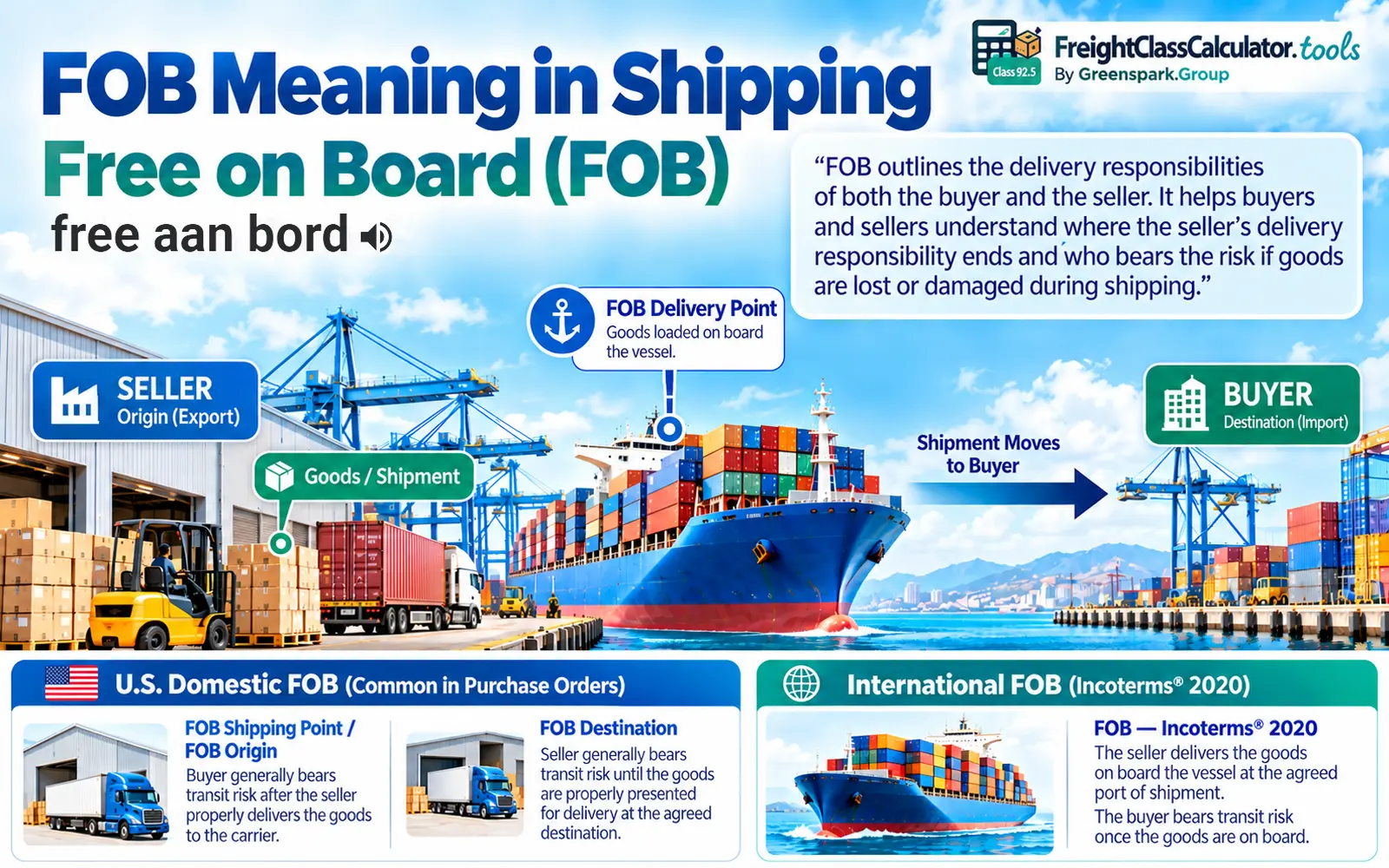
FOB is a shipping acronym for Free on Board. It identifies the delivery responsibilities of the buyer and seller and helps establish which party bears the risk of loss or damage during shipping.
What Does FOB Mean in Freight Shipping?
FOB stands for Free on Board. FOB outlines the delivery responsibilities of both the buyer and the seller. It helps buyers and sellers understand where the seller's delivery responsibility ends and who bears the risk if goods are lost or damaged during shipping.
To determine delivery responsibility and who bears the risk, two terms are usually found on U.S. purchase orders, sales agreements, and invoices: FOB Shipping Point (FOB Origin) and FOB Destination. Another important term is the delivery point. This is the mutually agreed location where the seller completes delivery.
What Does FOB Shipping Point (FOB Origin) Mean?
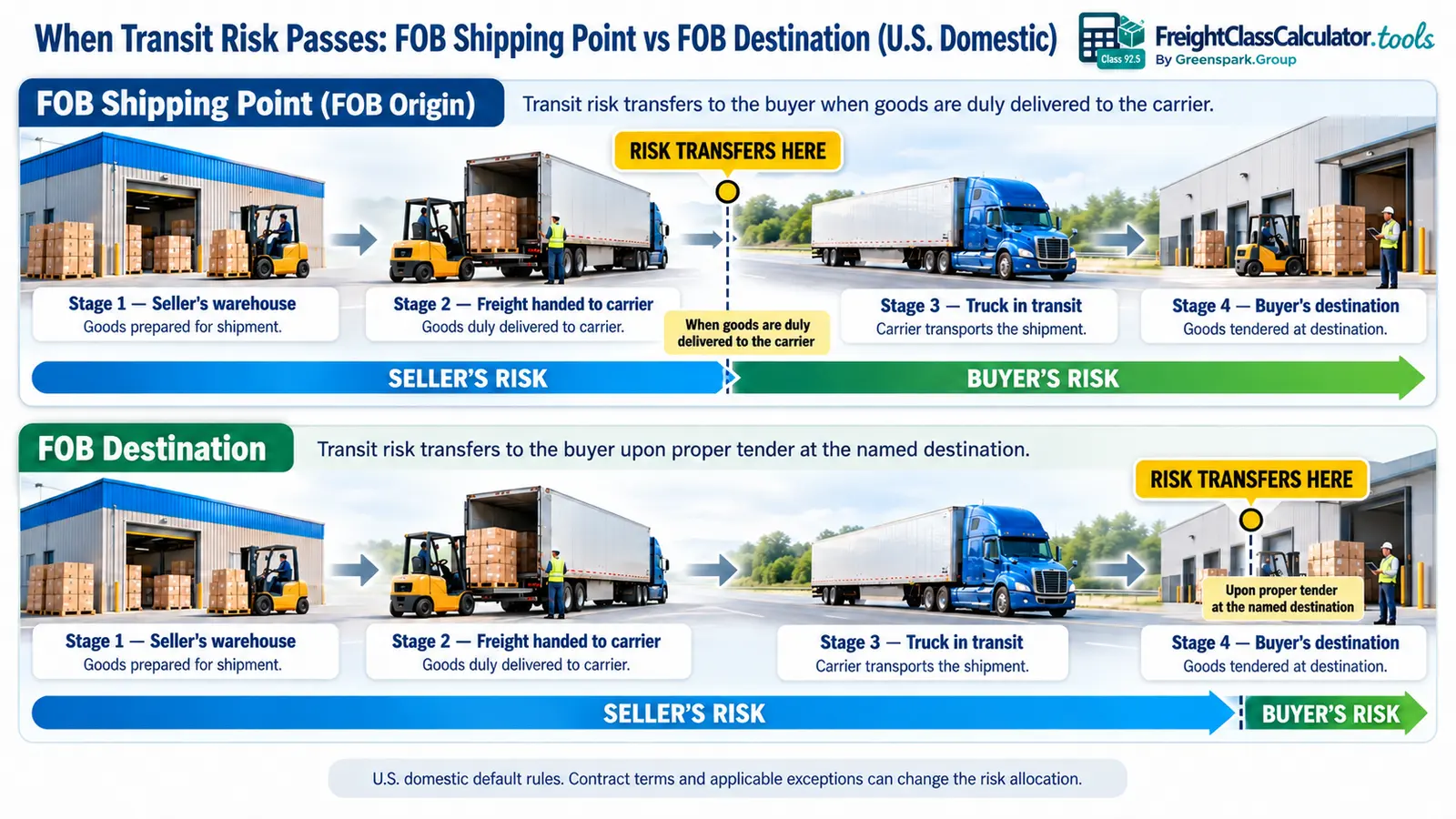
When FOB Shipping Point is specified, the buyer bears the risk of loss or damage once the seller has properly delivered the goods to the carrier. §2-504§2-319§2-509. Now, take for example, ABC Motors, a car dealership based in New York. The company sells a car to a buyer in Atlanta and arranges to ship it from New York. If the agreed delivery point is the shipping point Shipping point: The agreed location where the seller hands the goods to the transport carrier, often the seller’s warehouse or loading location. in New York, the buyer generally bears the risk once the car is properly handed to the carrierCarrier: The trucking company or other transport business that moves the goods from the seller toward the buyer..
What does FOB destination mean?
In the case of FOB Destination, the seller bears that risk until the goods are properly presented for delivery at the agreed destination. §2-319§2-509 Using the same example, if the agreed delivery point is the destination in Atlanta, ABC Motors generally bears the risk during the transit, until the car is properly presented for delivery.
DOMESTIC SHIPPING
FOB Shipping Point vs FOB Destination
These are two U.S. delivery terms that determine where delivery occurs, who bears transit risk, and who normally pays freight.
The table below shows the usual rules when the buyer and seller have not agreed to different terms.
Question
FOB Shipping Point / FOB Origin
FOB Destination
What is the seller's responsibility?
The seller must properly hand the goods to the carrier at the shipping point.
The seller must get the goods to the agreed destination and properly present them for delivery.
Who bears the risk during shipping?
The buyer bears the risk once the seller properly hands the goods to the carrier.
The seller bears the risk until the goods are properly presented for delivery at the agreed destination.
Who normally pays for shipping?
The seller pays to get the goods to the carrier. The buyer generally pays for shipping from the shipping point.
The seller generally pays for shipping to the agreed destination.
If the truck crashes during transit, who bears the loss?
The loss is generally borne by the buyer.
The loss is generally borne by the seller.
Lost or Damaged Freight: A Practical Example
What if the car arrives damaged? Suppose the carrier scratches the car during the trip. With FOB Shipping Point, the buyer generally bears that accidental transit risk after proper handoff in New York. With FOB Destination, ABC Motors generally bears it until proper tender in Atlanta. A claim against the carrier may still be possible; the FOB term alone does not settle that claim.
What should the buyer do next? Make sure to record the damage on the delivery paperwork, take clear photos, and preserve the carrier records. You must also notify the seller and carrier promptly. The parties should check the sales agreement and bill of lading to find out who can pursue a carrier claim. The party bearing transit risk is not automatically the party entitled to recover from the carrier.
Risk is not the same as carrier liability. FOB helps establish whether the buyer or seller bears an accidental loss. This does not guarantee that the carrier will reimburse the full value. The shipping agreement, liability limits, and applicable exceptions are other factors that can affect a claim. Under the Uniform Commercial Code (UCC) Uniform Commercial Code: U.S. commercial laws governing transactions such as the sale of goods., different risk rules may apply if the seller ships goods that do not meet the agreed requirements and the buyer rightfully rejects them. §2-510
What does “properly” mean? The seller must meet the applicable delivery requirements. For a shipment contract, this can include making reasonable transportation arrangements and notifying the buyer.
View larger image ↗Compare the risk-transfer points for the same New York-to-Atlanta shipment under the two U.S. FOB terms.
FREIGHT RESPONSIBILITY
Who Pays for Freight? Prepaid vs Collect Explained
Once the buyer and seller have agreed to the delivery point, the next decision is who pays the freight. The party that pays the freight is not necessarily the party that bears the risk of loss or damage during transit.The table below explains six common FOB freight arrangements, showing who the carrier bills, who ultimately pays the freight costs, and who bears the transit risk.
FOB Freight Terms Chart:Prepaid, Collect, and Who Pays6 Common Arrangements
This chart shows six common FOB freight arrangements, including who the carrier bills, who typically pays the freight cost, and when shipping risk transfers.
▤ FOB Freight Terms
▧ Carrier Bills
▥ Freight Cost Usually Paid By
⬡ Transit Risk
● FOB Origin / Shipping Point
FOB Origin, Freight Collect
Buyer
Buyer
The buyer bears the risk once the seller properly hands the goods to the carrier.
FOB Origin, Freight Prepaid
Seller
The seller pays unless otherwise agreed.
The buyer bears the risk once the seller properly hands the goods to the carrier.
FOB Origin, Freight Prepaid & Add
Seller
The buyer pays through a freight charge added to the seller's invoice.
The buyer bears the risk once the seller properly hands the goods to the carrier.
▤ FOB Freight Terms
▧ Carrier Bills
▥ Freight Cost Usually Paid By
⬡ Transit Risk
▣ FOB Destination
FOB Destination, Freight Prepaid
Seller
Seller
The seller bears the risk until the goods are properly presented for delivery at the agreed destination.
FOB Destination, Freight Collect
Buyer
Buyer pays the carrier; who ultimately bears the expense depends on the sales agreement. Under the usual U.S. FOB Destination rule, the seller bears transportation expense unless otherwise agreed.
The seller bears the risk until the goods are properly presented for delivery at the agreed destination.
FOB Destination, Freight Collect & Allowed
Buyer
The seller covers the freight cost by giving the buyer a credit or deduction.
The seller bears the risk until the goods are properly presented for delivery at the agreed destination.
▰Freight Prepaid:The shipper pays the carrier.
▤Freight Collect:The consignee or designated receiving party is billed by the carrier.
▣Prepaid & Add:The shipper pays the carrier and adds the freight charge to the customer’s invoice.
$Collect & Allowed:The buyer pays the carrier and receives an agreed allowance or deduction from the seller.
⚖ Common U.S. domestic freight arrangements. Carrier billing, ultimate freight expense, and transit risk are separate matters. The sales agreement and applicable law control.
Example: a $400 car-transport bill. ABC Motors sends a car from New York to Atlanta. With Prepaid & Add, ABC Motors pays the carrier $400 and includes that charge on the buyer's invoice. With Collect & Allowed, the buyer pays the carrier but receives an agreed $400 allowance from ABC Motors. That's why the carrier's bill and the party ultimately paying for shipping aren't always the same.
READING SHIPPING TERMS
Where Do You Find FOB Terms on Shipping Documents?
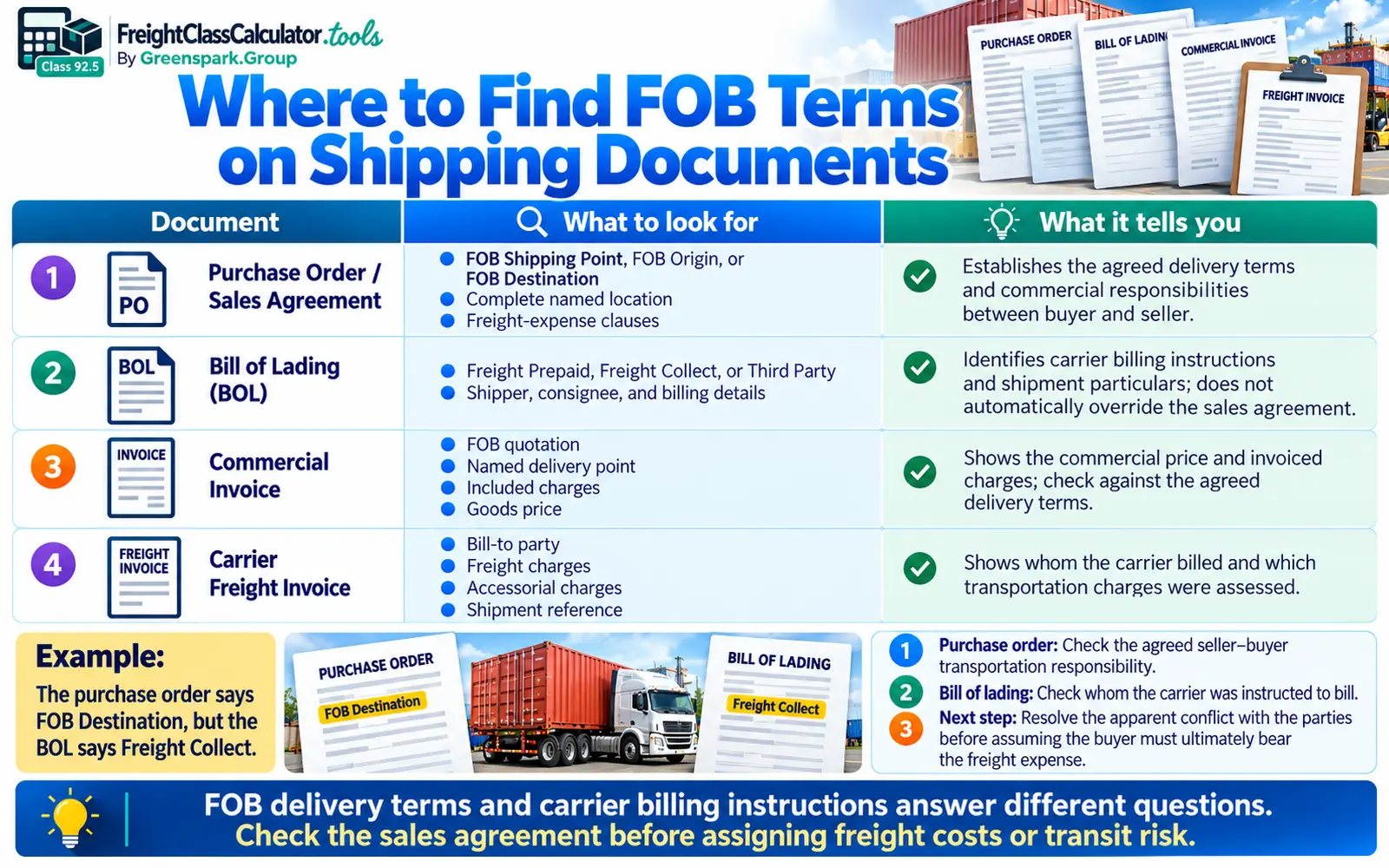
FOB terms commonly appear on purchase orders, sales agreements, bills of lading, and invoices. The table below explains what to look for in each document.
Document
⌕ What to look for
♧ What it tells you
1POPurchase Order / Sales Agreement
FOB Shipping Point, FOB Origin, or FOB Destination
Complete named location
Freight-expense clauses
✓Establishes the agreed delivery terms and commercial responsibilities between buyer and seller.
2BOLBill of Lading (BOL)
Freight Prepaid, Freight Collect, or Third Party
Shipper, consignee, and billing details
✓Identifies carrier billing instructions and shipment particulars; does not automatically override the sales agreement.
3INVOICECommercial Invoice
FOB quotation
Named delivery point
Included charges
Goods price
✓Shows the commercial price and invoiced charges; check against the agreed delivery terms.
4FREIGHT INVOICECarrier Freight Invoice
Bill-to party
Freight charges
Accessorial charges
Shipment reference
✓Shows whom the carrier billed and which transportation charges were assessed.
Example:The purchase order says FOB Destination, but the BOL says Freight Collect.
PURCHASE ORDERFOB Destination
🚚
BILL OF LADINGFreight Collect
1Purchase order: Check the agreed seller–buyer transportation responsibility.
2Bill of lading: Check whom the carrier was instructed to bill.
3Next step: Ask the buyer and seller to confirm who is responsible for the shipping cost.
💡FOB delivery terms and carrier billing instructions answer different questions. Check the sales agreement before assigning freight costs or transit risk.
RISK AND COVERAGE
FOB Risk Transfer, Ownership and Insurance
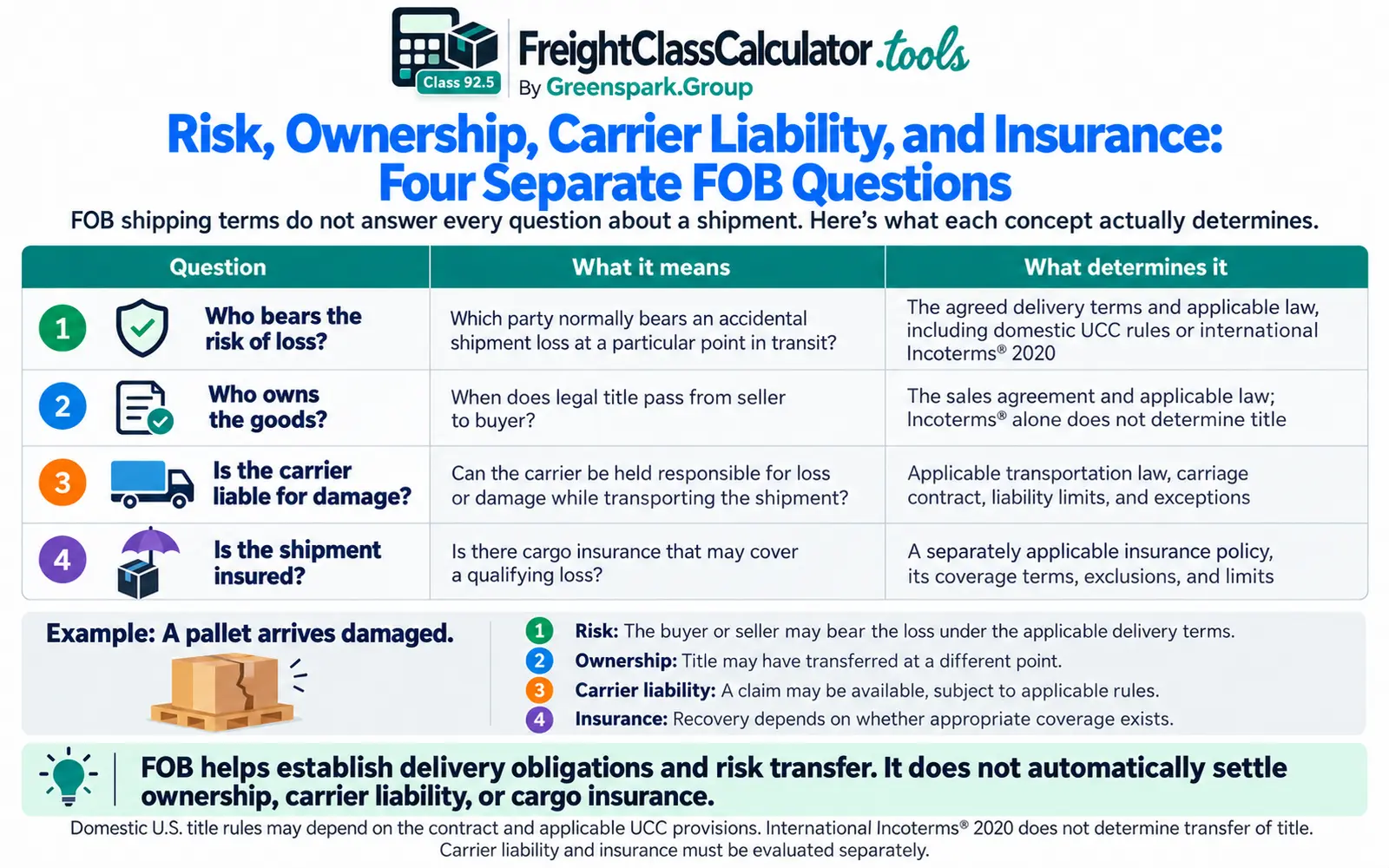
The four points below explain who bears the risk, who owns the goods, who is responsible for damage, and whether the shipment is insured.
1
Who bears the risk of loss?
The buyer or seller bears the risk according to the agreed shipping terms and applicable rules.
2
Who owns the goods?
Ownership depends on the sales agreement and applicable law. International FOB does not determine ownership.
3
Is the carrier liable for damage?
Carrier liability depends on transportation agreements, applicable rules, and liability limits.
4
Is the shipment insured?
Coverage depends on whether cargo insurance was purchased and what the policy covers.
Example: A pallet arrives damaged.
1Risk: The buyer or seller may bear the loss under the applicable delivery terms.
2Ownership: Ownership may have passed to the buyer at a different stage of shipping.
3Carrier liability: The carrier may be responsible for damage, depending on the shipping agreement and applicable rules.
4Insurance: An insurance claim depends on the coverage and conditions of the policy.
✦FOB helps establish delivery obligations and risk transfer. It does not automatically settle ownership, carrier liability, or cargo insurance.
Important: The examples on this page describe standard shipping arrangements. A sales contract, applicable law or a specific exception may change the outcome for an individual shipment.
U.S. DOMESTIC SHIPPING
Domestic FOB: Additional Reading
Practical Shipping Questions
What Does FOB Shipping Point or FOB Destination NOT Automatically Determine?
Who pays the freight bill: The delivery term does not necessarily tell you who the carrier bills or who ultimately bears the freight expense. Check the agreed freight payment arrangements.
Who owns the goods: Transit risk and legal ownership do not necessarily transfer together. Ownership depends on the sales agreement and applicable law.
Does FOB include cargo insurance?
No. FOB does not automatically include cargo insurance. The party bearing transit risk should consider arranging appropriate coverage for loss or damage. Insurance protection depends on the policy’s terms, limits, and exclusions.
Does FOB determine when the buyer owns the goods?
Not necessarily. Ownership and risk of loss are separate questions. U.S. domestic FOB terms may help establish when ownership passes, subject to the sales agreement and applicable law. §2-401 International FOB under Incoterms® 2020 does not determine ownership.
Who Can File a Carrier Claim for a Damaged FOB Shipping Point Shipment?
Under FOB Shipping Point, the buyer generally bears accidental transit risk after the seller properly delivers the goods to the carrier. That does not automatically determine who may bring a claim against the carrier. The bill of lading, transportation agreement, applicable law and the parties’ rights determine who can pursue recovery. Buyer and seller should confirm which party will handle the claim.
Does FOB Destination Include Liftgate, Detention or Unloading Fees?
No. Not automatically. A liftgate service, driver waiting time (detention), and unloading may generate additional charges. FOB Destination sets out delivery obligations, but it does not by itself specify every accessorial service or establish the amount of each acrrued fee. Make sure to check the sales agreement and transportation quote to confirm who authorizes and pays for these services.
U.S. Domestic FOB and Air Freight
U.S. domestic FOB Shipping Point and FOB Destination terms can also apply to shipments moved by air or truck, because those terms follow a different legal framework.
Who Reports Goods in Transit as Inventory?
Goods shipped under FOB Shipping Point are often recorded in the buyer’s inventory after the seller properly delivers them to the carrier. Under FOB Destination, they often remain in the seller’s inventory until delivery at the agreed destination. Actual recognition depends on the contract, the substance of the transaction and the accounting standards used; risk transfer and legal title are relevant but are not always the only tests.
INTERNATIONAL SHIPPING
What Is FOB Under Incoterms® 2020?
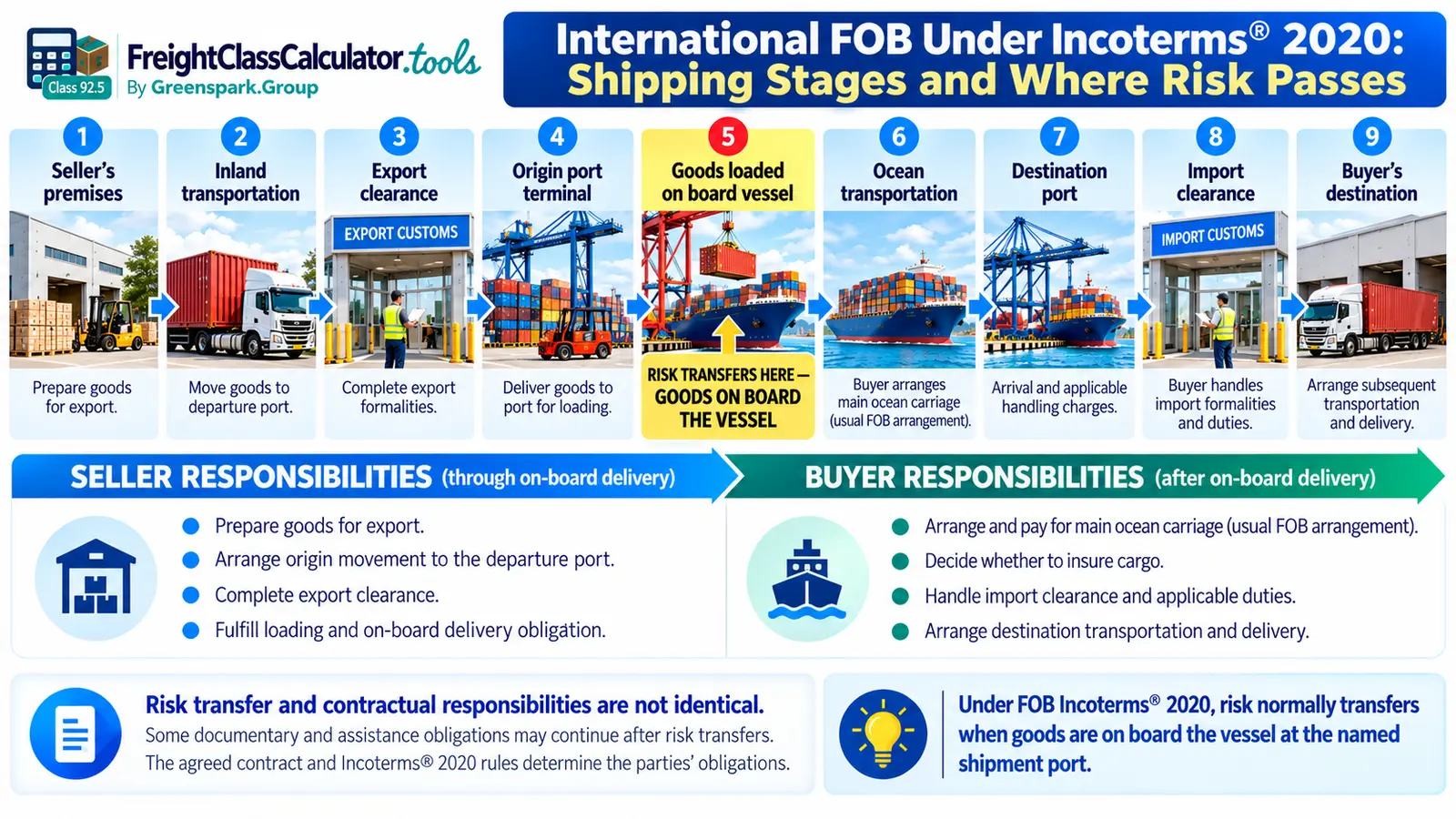
International FOB (Free on Board) is an international trade term established by the International Chamber of Commerce (ICC) under Incoterms® 2020. It applies to sea/ocean and inland waterway shipping. Under FOB (Incoterms® 2020), the seller must deliver the goods on board the vessel at the agreed port of shipment. Once the goods are on board, the buyer bears the risk of loss or damage during the remaining transit.
For example, ABC Motors is a car dealership in New York that exports a car to a buyer in Mumbai, India. Under FOB New York — Incoterms® 2020Incoterms® 2020: International trade rules that explain the delivery duties, costs, and shipping risks agreed between buyer and seller., ABC Motors completes delivery when the car is loaded on board the vessel at the agreed port of shipment in New York. From that point, the buyer generally bears the risk of loss or damage during the ocean journey to Mumbai. The risk does not wait until the car arrives in India. Incoterms® 2020
💡Important Points
Is international FOB the same as FOB Origin? They are similar, but not identical. Under U.S. FOB Origin, risk generally passes when the goods are properly handed to the carrier. Under international FOB, risk passes when the goods are loaded on board the vessel at the departure port.
How to State an International FOB Term
An international FOB term names the port where the goods are loaded, followed by the Incoterms edition. ABC Motors ships a car from New York to Mumbai under FOB New York — Incoterms® 2020. ABC Motors clears it for export and arranges loading onto the buyer’s nominated vessel. The buyer arranges and pays for the ocean trip to Mumbai. In some commodity trades, FOB also permits delivery by procuring goods already on board.
An international quote marked “FOB Los Angeles” should identify Los Angeles as the port of loading.
FOB applies only to sea and inland waterway transport. It is not the Incoterms® rule for air freight or multimodal delivery to a container terminal.
Seller prepares and clears goods for export. The seller takes care of export paperwork before the goods are loaded.
Goods are placed on board the vessel. The buyer takes on shipping risk once the goods are loaded onto the ship at the agreed departure port.
Buyer arranges main carriage. The buyer arranges and pays for ocean freight and decides whether to purchase cargo insurance.
View larger image ↗Under international FOB, the buyer takes on shipping risk once the goods are loaded onto the ship at the agreed departure port.
Typical Costs & Who is Responsible Under FOB Incoterms® 2020
Shipping Costs & Services
Who Pays or Is Responsible
Export packing, origin movement and export clearance
The seller covers these costs through loading the goods onto the vessel.
Port handling and loading before goods are on board
The seller pays to get the goods on board. Check which port fees are included.
Main ocean carriage and optional marine insurance
The buyer arranges and pays for the main ocean carriage and decides whether to purchase marine cargo insurance.
Destination charges, import clearance, duties and final delivery
The buyer generally pays these costs. The exact charges depend on the arrangements at the destination.
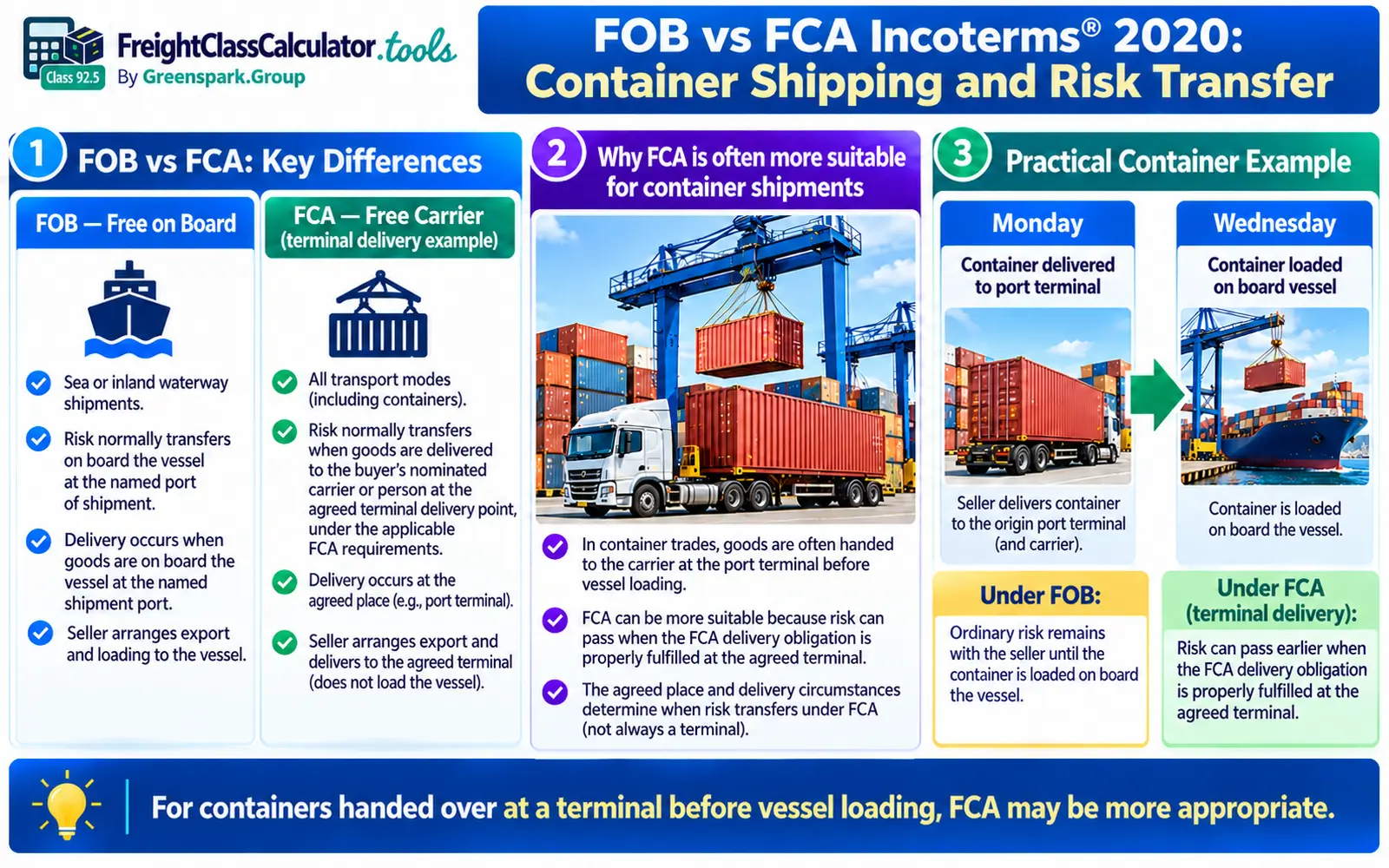
View larger image ↗If a shipping container is handed to a carrier at the terminal before it is loaded onto the ship, FCA may fit the shipment better than FOB.
PRICE AND VALUE
What Is an FOB Price?
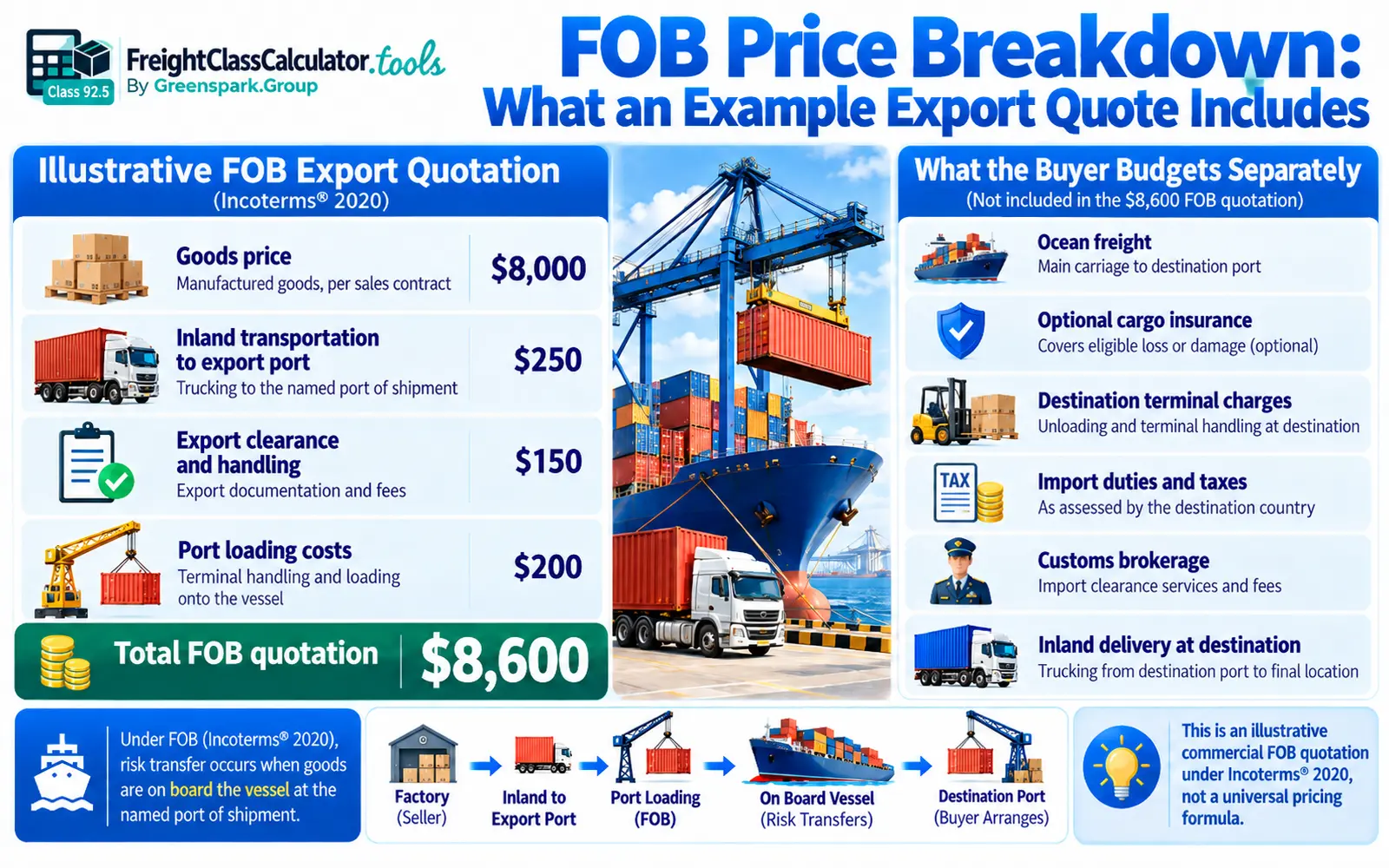
Under international FOB (Incoterms® 2020), the FOB price includes the cost of the goods and the seller's expenses to get them loaded on board the vessel at the agreed port of shipment. It does not include the main ocean freight, marine cargo insurance, or any additional costs incurred at the destination.
Continuing our New York-to-Mumbai example, suppose ABC Motors quotes the buyer $8,600 FOB New York for a used car. The chart below breaks down that quotation and shows which additional shipping costs the buyer must budget for.
🚛Transport to export portVehicle transport to the agreed departure port
$250
📋Export clearance and handlingExport documentation and fees
$150
🏗️Port loading costsVehicle handling and loading onto the vessel
$200
🪙 Total FOB quotation
$8,600
What the Buyer Budgets Separately (Not included in the $8,600 FOB quotation)
🚢Ocean freightMain carriage to destination port
🛡️Optional cargo insuranceCovers eligible loss or damage (optional)
🏗️Destination terminal chargesUnloading and terminal handling at destination
🧾Import duties and taxesAs assessed by the destination country
👮Customs brokerageImport clearance services and fees
🚚Inland delivery at destinationTrucking from destination port to final location
🏭Factory (Seller)→🚛Inland to Export Port→🏗️Port Loading (FOB)→🚢On Board Vessel (Risk Transfers)→🏗️Destination Port (Buyer Arranges)
💡This is an illustrative commercial FOB quotation under Incoterms® 2020, not a universal pricing formula.
Reading ABC Motors’ “FOB New York” Quote
For ABC Motors’ FOB New York — Incoterms® 2020 quotation, the Mumbai buyer should confirm which New York terminal, handling, and vessel-loading charges are included in the $8,600. The buyer can then compare those charges with the freight forwarder’s ocean-shipping quote to avoid paying twice for the same service.
A supplier’s FOB selling price may also differ from the value customs authorities require for import or export declarations.
How is FOB value calculated for exports? For a commercial FOB quotation, start with the goods price and include the agreed seller costs through vessel loading, without counting any charge twice.
FOB value for customs purposes: Customs authorities may use different valuation rules when determining the value that must be declared on official shipping documents.
INTERNATIONAL COMPARISON
FOB vs Other Incoterms® 2020 Shipping Terms
The delivery-risk point is the same for all three ocean terms. What changes is who arranges and pays for the ocean trip and insurance.
FOB vs CFR vs CIF: Who Pays Freight and Insurance?
Same shipment, three possible terms: ABC Motors ships a car from New York to Mumbai. Under FOB New York, the buyer arranges and pays for the ocean voyage. Under CFR Mumbai, ABC Motors pays for ocean carriage to Mumbai. Under CIF Mumbai, ABC Motors also provides the required cargo insurance. In all three cases, risk normally passes when the car is on board the vessel in New York.
FOBFree On Board
🚢
Seller delivers goods on board vessel at shipment port.
✓
Risk transfers on board at shipment port.
$
Buyer contracts and pays for ocean freight to destination port.
♢
Buyer decides whether to insure cargo.
CFRCost and Freight
🚢
Seller delivers goods on board vessel at shipment port.
✓
Risk transfers on board at shipment port.
$
Seller pays ocean freight to destination port.
♢
Buyer decides whether to insure cargo.
CIFCost, Insurance and Freight
🚢
Seller delivers goods on board vessel at shipment port.
✓
Risk transfers on board at shipment port.
$
Seller pays ocean freight to destination port.
✓
Seller provides cargo insurance for the buyer’s benefit.
💡Key Takeaway
FOB, CFR, and CIF differ in freight cost and insurance obligations, but the risk-transfer point is the same: goods on board the vessel at the shipment port.
Term Definitions (Ocean Shipping)
FOBFree On BoardCFRCost and FreightCIFCost, Insurance and Freight
The sales agreement should identify the applicable trade term, departure port, and included shipping costs.
Incoterms® allocates obligations, risk and costs; it does not provide a universal formula for setting the seller's commercial price or establish when ownership transfers.
When comparing supplier quotations, request an itemized breakdown of the charges included at origin and destination. A CIF price includes the required freight and insurance, but it does not necessarily include every cost after the vessel arrives. Compare the full landed cost—not just the quoted goods price—before choosing an offer.
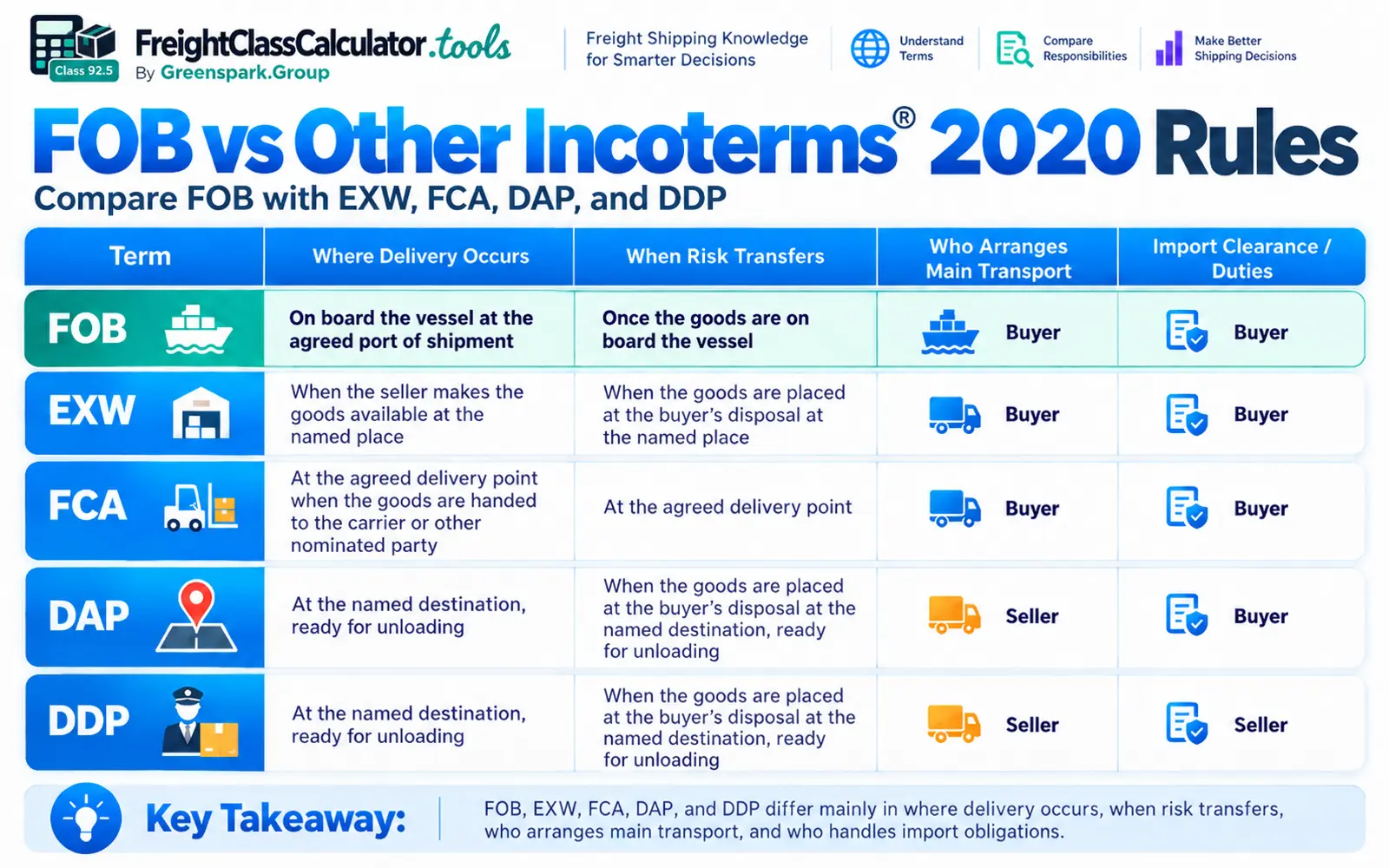
FOB vs EXW, FCA, DAP and DDP
FOB is one of several Incoterms® 2020 rules used in international trade. The table below shows how FOB compares with EXW, FCA, DAP, and DDP, particularly where delivery occurs and when the buyer takes on shipping risk.
Comparison
Main Difference
When Does the Buyer Bear Risk?
FOB vs EXW (Ex Works)
Under EXW, the seller makes goods available at the agreed location. Under FOB, the seller delivers them on board the vessel.
EXW: When goods are placed at the buyer’s disposal at the named place, not loaded on a collecting vehicle. FOB: Once goods are on board the vessel.
FOB vs FCA (Free Carrier)
FCA uses an agreed carrier handover point; FOB requires delivery on board the vessel.
FCA: At the agreed delivery point, once the applicable delivery requirements are met. FOB: On board the vessel.
FOB vs DAP (Delivered at Place)
Under DAP, the seller arranges and pays for transport to the named destination.
DAP: When goods are placed at the buyer’s disposal at the named destination, ready for unloading. FOB: Once goods are on board the vessel at the shipment port.
FOB vs DDP (Delivered Duty Paid)
Under DDP, the seller also handles import clearance and applicable import duties. Under FOB, those obligations belong to the buyer.
DDP: When import-cleared goods are placed at the buyer’s disposal at the named destination, ready for unloading. FOB: Once goods are on board the vessel at the shipment port.
DEEPER EXPLANATIONS
International FOB: Additional Reading
Further guidance on special shipping arrangements, freight charges, carrier claims and accounting.
Practical Shipping Questions
Can FOB Be Used for Air Freight?
Under international Incoterms® 2020, FOB is only for sea and inland waterway transport; it is not an air-freight rule. FCA (Free Carrier) may be more appropriate when the seller delivers goods to an air carrier at an agreed location.
Advanced Trade and Accounting Notes
How Does FOB Compare with EXW (Ex Works)?
Under EXW, the seller makes the goods available at a named place, such as a factory, while the buyer generally takes responsibility for collection and most subsequent transport arrangements. Under international FOB, the seller clears the goods for export and delivers them on board the buyer’s nominated vessel at the named shipment port. The terms assign different tasks and costs, so compare the full shipping arrangements rather than just the quoted goods price.
Vessel Nomination, Loading Notices and Shipping Documents Under International FOB
The buyer normally arranges the vessel and provides the seller with the information needed to deliver the goods for loading at the agreed port. Incoterms® 2020 addresses circumstances in which required notice is not given or the nominated vessel does not arrive or take the goods as arranged. The specific duties and consequences depend on the agreed FOB term and the relevant rule.
After delivery on board, the seller must provide the customary proof of delivery and may have to assist with transport-related information or documents at the buyer’s request, with costs allocated under the agreed arrangements. These delivery and documentation obligations do not decide when ownership transfers.
FOB Visual Guides
Explore these supplementary FOB shipping reference images. Select any thumbnail to view it larger.
FOB Meaning in ShippingA visual explanation of Free on Board and the different delivery and risk-transfer points under U.S. domestic and international FOB.Where to Find FOB Terms on Shipping DocumentsA visual reference for identifying FOB terms and freight billing information on shipping documents.FOB Price Breakdown: Included and Additional CostsA sample export quotation illustrating which costs can be included in an FOB price.FOB Risk, Ownership, Liability and InsuranceA visual comparison of four related questions that FOB does not necessarily answer together.FOB vs Other Incoterms® 2020 RulesCompare FOB with EXW, FCA, DAP and DDP across delivery points, shipping risk, main transport and import responsibilities.
Glossary of FOB Shipping Terms
Quick definitions of the freight and shipping terms used throughout this guide.
Bill of Lading (BOL)
A shipping document issued by a carrier that records shipment details and the terms under which the goods are transported.
A shipping term that allocates delivery responsibilities and risk between buyer and seller; its specific meaning differs between U.S. domestic trade and Incoterms® 2020.
A U.S. shipping term under which the seller generally bears transit risk until the goods are properly presented for delivery at the agreed destination.
An Incoterms® rule under which the seller delivers goods to a carrier or another party nominated by the buyer at an agreed location. Often better suited to container shipments than FOB.
Delivery that satisfies the applicable contract and legal requirements. In a shipment contract, this can include suitable transport arrangements and notice to the buyer.
This article is provided by FreightClassCalculator.tools, operated by Greenspark.Group LLC, for general educational and informational purposes. Shipping responsibilities, costs, risk of loss, and legal obligations may vary according to the sales agreement, applicable law, and individual shipment circumstances. Readers should consult the relevant agreements and official sources when making shipping or contractual decisions.
Trademarks and Attribution: Incoterms® and the Incoterms® 2020 logo are trademarks of the International Chamber of Commerce (ICC). The Incoterms® Rules are protected by copyright owned by ICC. Use of these trademarks does not imply association with, approval of, or sponsorship by ICC. Further information is available from the ICC website.
The Uniform Commercial Code (UCC) and other third-party sources referenced in this article are acknowledged for informational and educational purposes. References to these organizations or publications do not imply endorsement, affiliation, or sponsorship.